

Wispr Flow is a polished cross-app voice writing tool, but it is not the right fit for every buyer. Some people need true offline transcription, a built-in free option, Android or Windows support, a one-time purchase, or a recorder that keeps sensitive audio on the phone. This guide compares seven credible alternatives using the same practical criteria.
The best Wispr Flow alternative depends on your platform and privacy requirements. VoiceScriber is an option for offline iPhone transcription, while desktop and cross-platform users should compare dedicated dictation tools and built-in operating-system features. Check whether each alternative works across apps, processes speech locally and requires a recurring subscription.
Quick recommendations: the best Wispr Flow alternative for each need
For most buyers, platform and workflow matter more than a single overall ranking. Start with whether you need direct dictation into another app or a separate recorder/transcriber, then decide whether cloud processing is acceptable.
| Intent | Direct recommendation | Why | Important caveat |
|---|---|---|---|
| Best offline iPhone option | VoiceScriber for private recordings and imported files | On-device transcription, Airplane Mode workflow, local note library, search and export | It does not dictate directly into arbitrary app text fields |
| Best free offline iPhone option | Google AI Edge Eloquent | Free with no usage limit; current iOS release supports offline dictation after model download | Its iOS keyboard is still listed as coming soon; some optional non-English polish features may need internet |
| Best Mac alternative | Google AI Edge Eloquent | Free, system-wide hotkey, cross-app dictation and local voice editing on Mac | Newer product with less long-term track record than established paid tools |
| Best Windows alternative | Windows Voice Access | Built into Windows 11, works across apps and uses on-device speech after setup | No Wispr-style AI rewriting; language support is narrower |
| Best Android alternative | Gboard Advanced Voice Typing on Pixel 6 or newer | Text enters the active app; core advanced dictation keeps spoken text on-device | Feature, device and language availability are restricted; standard Gboard is not the same privacy/offline promise |
| Best cross-platform alternative | Typeless | Mac, Windows, iOS and Android with direct cross-app AI dictation | Transcription is cloud-processed, even though the vendor claims zero retention |
| Best configurable power-user option | Superwhisper | Cross-app dictation, local or cloud models, custom modes, file transcription and a lifetime plan | Privacy depends on model configuration; Windows and iOS do not have full Mac feature parity |
| Best built-in free alternative | Apple Dictation, Windows Voice Access or Pixel Gboard | No separate dictation subscription and deep operating-system integration | Advanced AI cleanup, file transcription and history are limited or absent |
| Best for local/private processing | Choose by device: VoiceScriber on iPhone, Eloquent on Mac, Voice Access on Windows | Each can complete its core transcription locally on the stated platform | “Local” may apply only to specific languages, models or features; verify the exact configuration |
Wispr Flow alternatives comparison table
The table distinguishes direct dictation, where speech appears in the active app, from recording transcription, where you capture or import audio and then copy, share or export text. Those are related workflows, but they are not interchangeable.
| Product | Best for | Platforms | Dictates directly into other apps? | Offline transcription | Cloud processing | Audio retention | Free tier | Current paid price | Languages | Main limitation | Last verified |
|---|---|---|---|---|---|---|---|---|---|---|---|
| VoiceScriber | Private iPhone recordings, interviews, lectures and imported audio | iPhone; iOS 17.6+ | No. Record/import, then copy, share or export | Yes | No cloud transcription | Stored on-device until the user deletes or shares it; App Store label says “Data Not Collected” | Free download/trial; public listing does not describe an unlimited permanent free plan | US App Store: $5.99/week or $49.99 lifetime | 100+ transcription languages claimed | iPhone-only and no system-wide dictation keyboard | Aug. 28, 2026 |
| Google AI Edge Eloquent | Free local AI dictation on Apple devices | iPhone, iPad, Mac | Mac: yes. iOS: no system-wide keyboard yet | Yes for Mac; core iOS dictation works offline after model download | Mac feature set is local; some optional iOS features may use cloud | Core ML processing is local, but the iOS privacy label lists optional data collection categories | Permanently free as currently advertised, with no usage limit | $0 | Current iOS release notes list 15 dictation languages; Mac availability may differ | iOS keyboard is “coming soon”; young product | Aug. 28, 2026 |
| Apple Dictation | Fast, built-in voice typing on iPhone, iPad and Mac | iPhone, iPad, Mac | Yes, anywhere Apple exposes a text field | Yes in many languages; check the device setting | Can be server-processed in unsupported configurations or search contexts | Varies by device setting and opt-in choices; server audio is not stored by default according to Apple | Built into the OS | $0 beyond compatible Apple hardware | Many languages; features vary by language and region | Less AI cleanup, customization and transcript management | Aug. 28, 2026 |
| Windows Voice Access | Free offline dictation and hands-free control on Windows 11 | Windows 11 version 22H2+ | Yes, in supported text fields and apps | Yes after the language model is downloaded | No cloud required for core Voice Access after setup | On-device speech recognition for core use | Built into Windows 11 | $0 beyond compatible Windows hardware/license | Selected English, Spanish, French, German, Chinese, Japanese and Italian variants | Windows 11 only; basic formatting compared with AI tools | Aug. 28, 2026 |
| Gboard Advanced Voice Typing | Built-in Android dictation on newer Pixel devices | Pixel 6 or newer, including Fold and Tablet | Yes, in apps that accept Gboard input | Core advanced dictation is on-device; verify your language and model download | “Fix it,” detailed edits and some learning features can involve Google servers | Spoken text stays on-device for core advanced typing; optional learning/donation settings differ | Built into supported Pixel devices | $0 beyond supported hardware | Advanced mode supports a narrower set than standard Gboard; availability varies | Not a universal Android feature and not fully local for every optional feature | Aug. 28, 2026 |
| Superwhisper | Power users who want local/cloud model choice and custom modes | Mac, Windows, iPhone, iPad | Yes, text can land at the cursor in other apps | Yes with a local voice model; fully local AI post-processing is Mac-only | Optional cloud voice and language models | History is local; cloud providers are described as zero-retention API integrations | Permanent free tier with basic dictation and selected small local models | $8.49/month, $84.99/year or $249.99 lifetime | 100+ | Configuration complexity; Windows/iOS parity gaps | Aug. 28, 2026 |
| Typeless | Closest all-four-platform cloud alternative to Wispr Flow | Mac, Windows, iOS, Android | Yes | No | Transcription and limited context are processed in the cloud | Vendor claims zero retention for audio/context; history is local unless cloud sync is enabled | 8,000 words per week | $30/month or $12/month billed yearly | 100+ | No offline transcription; cloud context processing | Aug. 28, 2026 |
What to look for in a Wispr Flow alternative
A useful alternative should solve your actual voice workflow, not merely contain a microphone button. Compare every product on the same criteria before switching.
Cross-app dictation
Wispr Flow’s core value is that speech becomes polished text inside the app you are already using. A separate recorder that produces a transcript later can be valuable, but it is not equivalent. Ask whether the tool places text at the cursor in third-party apps, requires a custom keyboard, or relies on copy and paste.
Real-time dictation versus file transcription
Real-time dictation is for composing messages, documents and prompts. File transcription is for meetings, lectures, interviews and voice memos. Some alternatives support both; others specialize in one. VoiceScriber is strongest in the second category, while Apple Dictation, Windows Voice Access, Gboard, Superwhisper and Typeless are designed for direct text entry.
Offline versus zero-retention cloud processing
Offline processing means the speech-to-text model runs on your device. Zero-retention cloud processing means audio still leaves the device but the provider says it is deleted after processing. Both can reduce privacy risk compared with stored cloud history, but they are not the same architecture.
Editing and formatting commands
Check whether the tool automatically removes filler words, repairs false starts, adds punctuation, formats paragraphs, follows commands such as “rewrite this as a concise email,” or only outputs a literal transcript. Built-in operating-system tools are usually fast and free but less capable at AI rewriting.
Personal dictionary and context
Names, acronyms and specialist terms are a common source of errors. A personal dictionary can help, but context-aware products may inspect the active app name or surrounding text. Decide whether the accuracy benefit is worth that additional data access.
Supported platforms
“Cross-platform” should mean more than a shared account. Check whether the core feature exists on every platform, whether one license covers all devices, and whether Windows, iOS or Android editions have feature gaps.
Pricing model
Separate built-in free tools, permanent free tiers, limited free plans, trials and one-time purchases. A “free download” with a short trial is not the same as a free alternative. Also compare hardware requirements: Pixel-only or newer-device features are free only after you own compatible hardware.
Data retention and model training
Look for separate controls for audio storage, transcript history, model training, context awareness and diagnostic data. A vendor may offer zero retention at a third-party model provider while still storing history in its own cloud, or it may process locally while collecting unrelated analytics.
Accuracy under realistic conditions
Do not rely on an uncited “99% accurate” claim. A March 2026 open ASR benchmark compared 86 systems across 12 datasets and emphasized that there is no catch-all model and that word error rate alone does not capture speed, multilingual and long-form trade-offs. Research also shows that background noise and distribution shift can increase dangerous ASR hallucinations. Test your accent, microphone, room noise, names and domain vocabulary before committing.
Open ASR Leaderboard (March 2026) · ACL Findings research on ASR hallucination and distribution shift
How to compare Wispr Flow alternatives yourself
Use the same short sample with every app so you can compare the workflow, offline behavior and output on your own devices.
A repeatable seven-part check
- Airplane Mode: download required models first, disconnect Wi-Fi and cellular service, then confirm transcription completes, not just recording.
- Cross-app dictation: try Messages, Mail, Notes, a browser form and a third-party editor.
- Punctuation and formatting: dictate a short email with a list, new paragraph, date and number.
- Noisy environment: repeat the same sample with fan, cafe or road noise and inspect invented text.
- Proper nouns: include your name, company, product, acronym and one unusual place name.
- Export or copy workflow: measure how many taps it takes to move the result into the destination app.
- Free-limit check: verify word, minute, model, trial and device limits in your own account and region.
What changed in 2026
This market changed enough in 2026 that the old two-product comparison was no longer sufficient.
- Wispr Flow clarified its data controls: its August 18, 2026 page says transcription always occurs in the cloud and that the setting previously called Privacy Mode now controls whether data may be used to improve models.
- Google launched a serious local competitor: Google AI Edge Eloquent now offers system-wide, fully local Mac dictation and editing; its August iOS update expanded dictation to 15 languages.
- VoiceScriber expanded its iPhone workflow: the current 1.7.6 update adds Home Screen shortcuts for Quick Record and Import Audio; 1.7.5 added M4A, MP3 and WAV import.
- Windows’ built-in options diverged: Voice Access works offline after setup, while the familiar Win+H Voice Typing still uses online Azure Speech. Copilot+ “Fluid dictation” adds on-device cleanup on supported PCs, but it should not be confused with offline Voice Access.
The 7 best Wispr Flow alternatives in 2026
The order below prioritizes distinct high-intent use cases rather than pretending one tool wins every category.
1. VoiceScriber: best for offline iPhone recordings and transcription
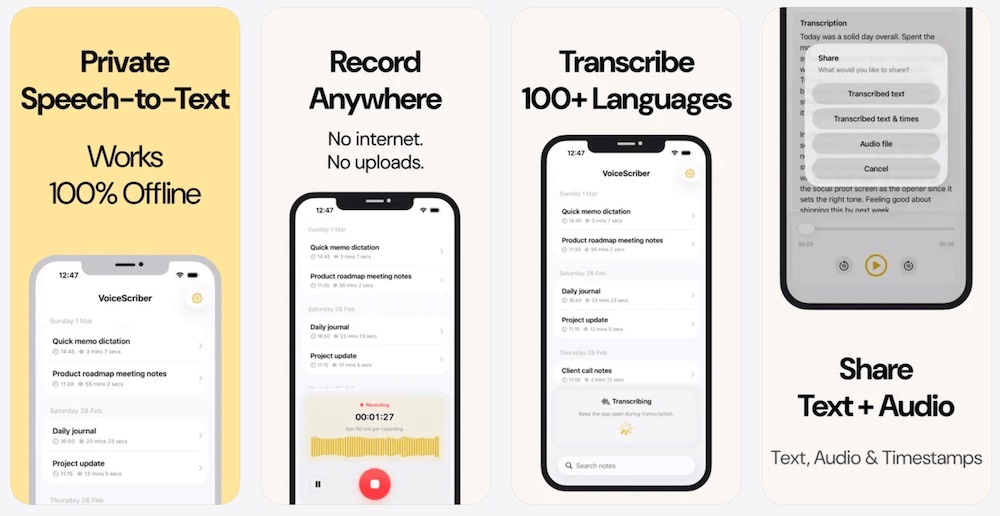
VoiceScriber is the best fit for iPhone users who need private recording or imported-audio transcription, not a system-wide replacement keyboard. It performs transcription on the iPhone, stores recordings and notes locally, works without an internet connection, supports search and export, and can import M4A, MP3 and WAV files. It is intentionally narrower than Wispr Flow.
- Who should use it? Journalists, students, interviewers, travelers and privacy-conscious professionals who record meetings, lectures, voice notes or files on iPhone.
- Platforms: iPhone only; the App Store says it is not verified for macOS.
- Direct dictation into third-party apps: No. You record or import audio, then copy, share or export the transcript.
- Offline capability: The product listing says the full transcription workflow runs on-device and works in Airplane Mode.
- Processing and retention: Audio and transcripts are stored locally. The current App Store privacy label says the developer does not collect data.
- Free access: Free to download and try, but the public listing does not promise an unlimited permanent free plan.
- Current price: The US App Store currently lists $5.99 weekly and $49.99 lifetime.
- What it does better than Wispr Flow: Local iPhone transcription, offline reliability, on-device note storage, imported-file workflow and a lifetime purchase.
- What it does worse: No cross-app keyboard, no desktop or Android app, and less automatic rewriting/formatting.
- Strongest reason not to choose it: You want to speak directly into Gmail, Slack, Messages, a browser or a code editor.
VoiceScriber App Store listing · VoiceScriber plans and purchase options
Need private iPhone transcription rather than a replacement keyboard?
VoiceScriber records or imports audio, transcribes it on-device and lets you search, edit, copy or export the result. Test your own Airplane Mode and proper-noun workflow before purchasing.
Try VoiceScriber on iPhone Scan to download
on your iPhone
2. Google AI Edge Eloquent: best free local AI dictation on Mac and iPhone
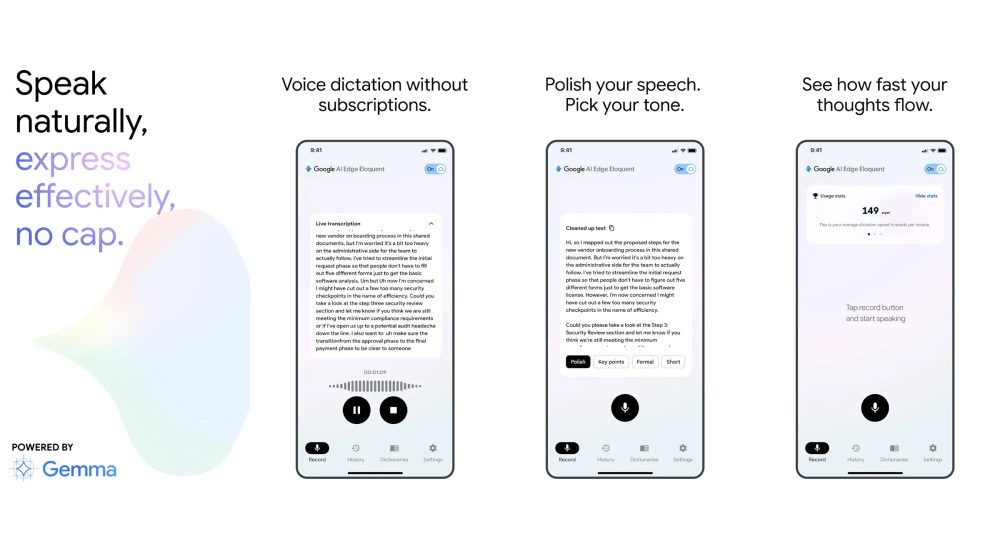
Google AI Edge Eloquent is the strongest new free alternative for Apple users who want local AI cleanup without a subscription. The Mac version can dictate across applications with a configurable hotkey and runs its full feature set on-device. On iPhone and iPad, core dictation works offline after a one-time model download, but the system-wide keyboard is still listed as coming soon.
- Who should use it? Mac users who want free, cross-app, local dictation and iPhone users comfortable with a standalone dictate-and-copy workflow.
- Platforms: macOS, iPhone and iPad.
- Direct dictation into third-party apps: Yes on Mac. Not yet through an iOS keyboard.
- Offline capability: Google describes the Mac version as 100% on-device across the entire feature set. The iOS developer response says dictation works offline after the improved model is downloaded.
- Processing and retention: Core machine-learning processing is local. The iOS listing warns that some advanced optional features use cloud processing and its privacy label lists several categories that may be collected depending on features.
- Free access: The App Store currently advertises no cost and no usage limit.
- Current price: $0.
- Languages: Version 1.4.1 release notes list English plus 14 additional dictation languages. Some non-English text styles and polish may still need an internet connection.
- What it does better than Wispr Flow: Free local processing, fully offline Mac workflows and local voice editing.
- What it does worse: No Android or Windows app, no current iOS keyboard, and a shorter product track record.
- Strongest reason not to choose it: You need mature cross-app mobile dictation today or require a simple privacy label with no optional data collection.
App Store observation: a recent reviewer reported microphone-selection trouble, and Google replied that version 1.4.1 improved automatic detection and added manual selection. This is useful release context, not evidence of average reliability.
Google AI Edge Eloquent · Google’s 2026 macOS launch details · iOS App Store listing
3. Apple Dictation: best built-in free option for iPhone and Mac
Apple Dictation is the simplest free Wispr Flow alternative when you only need speech to appear in the current text field. It is built into iPhone, iPad and Mac, supports punctuation and editing commands, and processes requests on-device in many languages without an internet connection.
- Who should use it? Apple users who need quick everyday messages, notes and documents without installing or subscribing to another app.
- Platforms: iPhone, iPad and Mac.
- Direct dictation into third-party apps: Yes, anywhere the operating system exposes a compatible text field.
- Offline capability: Apple says iPhone dictation is processed on-device in many languages. On Mac, Keyboard settings state whether your chosen configuration is on-device or needs internet.
- Processing and retention: If settings indicate server processing, audio is sent to Apple. Apple says server audio is not stored unless the user opts into Improve Siri and Dictation, although related request data and transcripts may be retained under its policy. Dictation in a search box may also be sent to the search provider.
- Free access: Permanently included with supported Apple operating systems.
- Current price: $0; no separate app purchase or subscription.
- Languages: Many, with feature and regional differences.
- What it does better than Wispr Flow: No separate account, no subscription, immediate keyboard integration and on-device operation in supported configurations.
- What it does worse: Less aggressive filler removal, rewriting, app-aware tone formatting, personal vocabulary learning and transcript history.
- Strongest reason not to choose it: You want polished long-form drafting, reusable custom instructions, file transcription or a searchable recording library.
Apple Dictation on iPhone · Apple Dictation on Mac · Siri, Dictation and Privacy
4. Windows Voice Access: best free offline Windows alternative
Windows Voice Access is the best no-cost starting point for offline dictation on Windows 11. After the initial language-file download, it uses on-device speech recognition to enter and edit text, open and switch apps, browse and control the PC without an internet connection.
- Who should use it? Windows 11 users who value offline operation, accessibility and system control more than AI rewriting.
- Platforms: Windows 11 version 22H2 or later.
- Direct dictation into third-party apps: Yes, in supported text fields. It can also navigate UI controls.
- Offline capability: Yes after the selected speech language model is downloaded during setup.
- Processing and retention: Microsoft describes the core feature as on-device speech recognition.
- Free access: Permanently included with supported Windows 11 installations.
- Current price: $0 beyond the Windows device and licence.
- Languages: Selected variants of English, Spanish, French, German, Chinese, Japanese and Italian; check the current Microsoft list.
- Editing features: Voice commands, spelling window, custom vocabulary, punctuation and automatic punctuation.
- What it does better than Wispr Flow: Offline use, no recurring charge and broader hands-free computer control.
- What it does worse: No app-aware AI style transformation, fewer languages and Windows-only support.
- Strongest reason not to choose it: You use Windows 10, need an unsupported language, or want polished output without speaking commands.
Do not confuse Voice Access with Win+H Voice Typing. Microsoft says standard Voice Typing uses online Azure Speech and needs an internet connection. Voice Access is the Windows 11 feature documented for offline use after setup.
Set up Windows Voice Access · Dictate and edit with Voice Access · Microsoft Voice Typing requirements
5. Gboard Advanced Voice Typing: best built-in Android option on Pixel
Gboard Advanced Voice Typing is the strongest built-in Android alternative for supported Pixel devices. It dictates into the active app, adds punctuation, accepts editing commands and keeps the spoken text on-device for the core advanced voice-typing path. It is not a universal promise for every Android phone or every Gboard feature.
- Who should use it? Pixel 6-or-newer owners who want fast keyboard dictation without a separate subscription.
- Platforms: Pixel 6 or newer, including supported Fold and Tablet models.
- Direct dictation into third-party apps: Yes, wherever Gboard can enter text.
- Offline capability: Google says the text spoken through Advanced Voice Typing stays on the device. Required models or updates may need Wi-Fi first, so run an Airplane Mode test for your device and language.
- Processing and retention: Core Advanced Voice Typing is on-device. “Fix it” and detailed edits can send data to Google. Gboard’s separate learning systems may use federated learning, ephemeral server memory or voluntary audio donations according to settings.
- Free access: Permanently included on supported Pixel hardware.
- Current price: $0 as a keyboard feature, but compatible Pixel hardware is required.
- Languages: Advanced Voice Typing is limited to supported languages and locales; the current support page lists a narrower set than general Gboard typing.
- What it does better than Wispr Flow: No separate subscription, keyboard-native Android workflow and core on-device speech on supported Pixels.
- What it does worse: Pixel hardware gating, fewer advanced languages, less cross-platform continuity and optional cloud exceptions.
- Strongest reason not to choose it: You use a non-Pixel Android phone or need a policy guarantee that every voice and editing feature stays local.
Gboard Advanced Voice Typing · How Gboard learns from typing and dictation
6. Superwhisper: best configurable cross-app alternative for power users
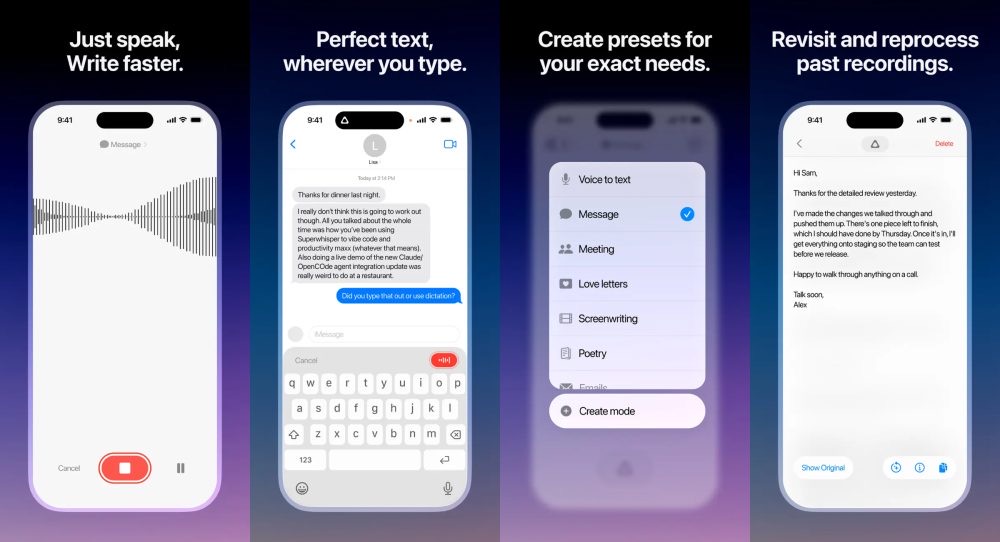
Superwhisper is the best option for users who want to choose between local and cloud models, create custom modes and dictate directly into other apps. It supports Mac, Windows, iPhone and iPad, offers a permanent free tier, and sells monthly, annual and lifetime Pro licenses.
- Who should use it? Writers, developers, accessibility users and professionals who will configure models and modes for different workflows.
- Platforms: macOS, Windows 10/11, iPhone and iPad. One Pro license covers the supported platforms.
- Direct dictation into third-party apps: Yes; text can be placed at the cursor in another app.
- Offline capability: Yes with a local voice model. Superwhisper lists free small local Whisper models and larger Pro local models.
- Processing and retention: The voice-transcription stage and optional text post-processing stage are configured independently. A fully local setup keeps audio and text on-device. Local language models for AI post-processing are currently macOS-only; Windows users can keep voice transcription local and skip AI post-processing.
- Cloud use: Optional cloud voice and language models. The vendor says its API integrations use zero-data-retention agreements and do not train on user audio or text.
- Free access: Permanent free tier for voice dictation and basic transcription; free local Standard, Nano and Fast models are listed in the model documentation.
- Current price: $8.49 monthly, $84.99 annually or $249.99 lifetime.
- Languages: 100+.
- What it does better than Wispr Flow: Local model choice, file transcription, lifetime purchase, custom modes and BYOK options.
- What it does worse: More setup and decision-making; Windows lacks some Mac features, local AI post-processing is Mac-only, and iOS 26.4 currently requires an extra swipe back after starting third-party-keyboard dictation.
- Strongest reason not to choose it: You want a simple product with one clearly defined privacy architecture and identical features on every platform.
Superwhisper dictation overview · Local and cloud voice models · Sensitive-data configuration · Current Pro pricing · iOS 26.4 keyboard limitation
7. Typeless: best cloud-based alternative across all four major platforms
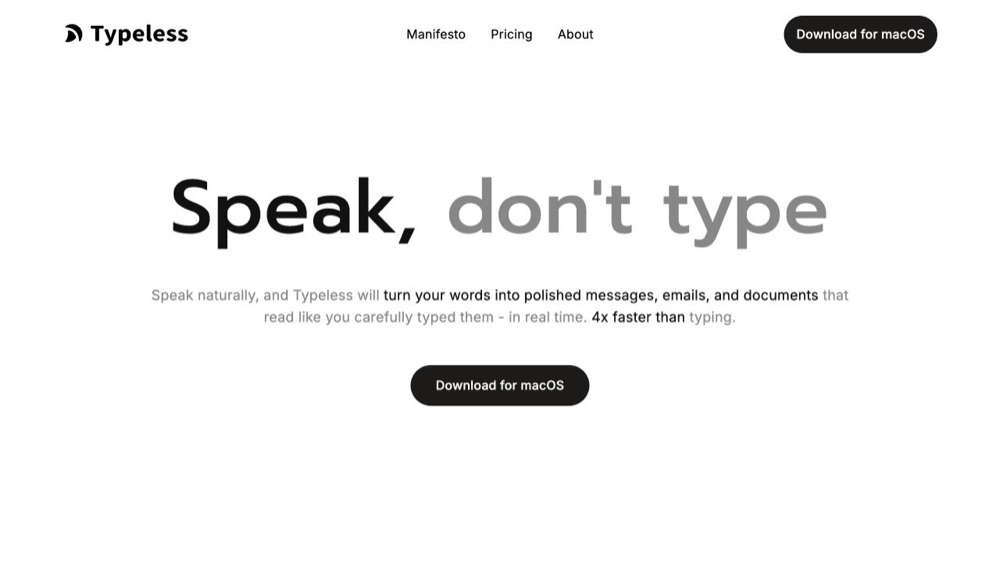
Typeless is the closest alternative for users who want Wispr-style AI dictation on Mac, Windows, iOS and Android. It dictates directly into apps, cleans up messy speech, supports personal vocabulary and offers a useful 8,000-word weekly free plan. The trade-off is that transcription is performed in the cloud.
- Who should use it? Users who switch among desktop and mobile platforms and accept zero-retention cloud processing.
- Platforms: macOS, Windows, iOS and Android.
- Direct dictation into third-party apps: Yes.
- Offline capability: No. Typeless says transcription is cloud-processed.
- Processing and retention: Audio and limited context such as app name and relevant text are processed on cloud servers. The vendor says they are discarded when the result returns, are not used for training, and history remains local unless optional cloud sync is enabled.
- Free access: 8,000 words per week, standard accuracy and standard access during high demand.
- Current price: $30 per month or $12 per month billed yearly.
- Languages: 100+.
- What it does better than Wispr Flow: A larger public free allowance, broad four-platform availability and similar context-aware cleanup.
- What it does worse: No offline mode and a higher month-to-month list price than Wispr Flow Pro.
- Strongest reason not to choose it: Your policy requires speech never to leave the device.
Wispr Flow vs alternatives: what Flow still does well
Wispr Flow remains a strong choice for people who want polished cross-app dictation on every major platform and accept cloud processing. It combines fast voice input, filler removal, app-aware formatting, command-based edits, a personal dictionary and broad language support in a simpler package than a configurable model tool.
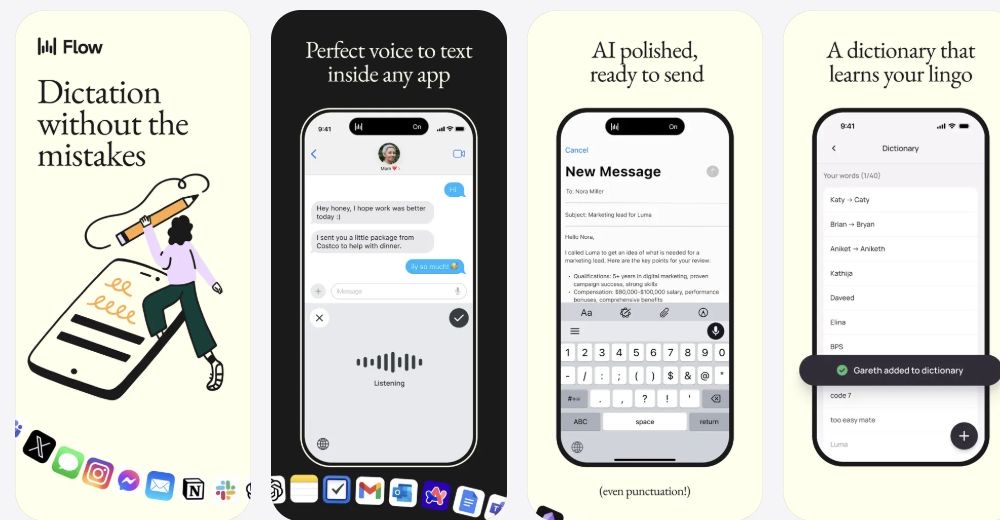
| Wispr Flow factor | Current verified position | Why it matters when comparing alternatives |
|---|---|---|
| Platforms | Dictation on Mac, Windows, iOS and Android; Notetaker is currently Mac-only | Few alternatives match all four major platforms with one consistent AI-writing product |
| Cross-app dictation | Yes, across supported apps and text fields | A recorder/transcriber is not a full replacement for this workflow |
| Free plan | Current pricing page shows 2,000 words/week on desktop, 1,000/week on iPhone and unlimited on Android | Compare the limit on the platform you actually use; free allowances are not uniform |
| Pro pricing | $15/user/month or $12/user/month billed annually | Built-in tools and Eloquent cost less; Superwhisper and VoiceScriber offer lifetime options |
| Languages | 100+ | Broader than many built-in advanced dictation modes |
| Offline transcription | No. Wispr says transcription always occurs in the cloud | Choose a local alternative if connectivity or no-upload policy is non-negotiable |
| “Privacy Mode” | The August 2026 Data Controls page says this name was replaced by an “Improve the model for everyone” setting | Turning off model improvement does not make transcription local |
| Model training | If enabled, Wispr may use audio, transcripts and edits to improve its models; third-party providers are not permitted to train on the data | Review the setting in every account and any organization-enforced policy |
| Cloud storage | Dictation Cloud Storage can store transcripts, audio and history; Notetaker transcripts use Wispr’s private cloud | Storage controls are separate from cloud transcription |
| Context | Wispr uses app name and surrounding text; optional Context Awareness can use relevant text from the active window | Context can improve formatting but expands the data being processed |
| Security | TLS encryption, SOC 2 Type II and ISO 27001 claims; HIPAA-ready dictation with a signed BAA | Security controls reduce cloud risk but are not equivalent to keeping speech on-device |
Wispr Flow’s major advantages
- One product across Mac, Windows, iPhone and Android.
- AI-polished output with filler removal, command mode and app-aware formatting.
- 100+ languages and personal vocabulary features.
- Simple onboarding compared with model-configurable tools.
- Business security, administration and BAA options.
Wispr Flow’s important limitations
- Transcription depends on cloud connectivity.
- Privacy settings control training and storage, not the location of speech processing.
- The recurring Pro subscription can cost more over time than built-in or lifetime alternatives.
- Context features can process app and surrounding text, which may not fit strict data-minimization policies.
For deeper answers, see whether Wispr Flow works offline on each platform, our current Wispr Flow pricing and privacy review, and the separate comparison of Wispr Flow versus Otter.ai.
Wispr Flow pricing · Wispr Flow Data Controls, updated August 18, 2026
Best Wispr Flow alternatives by platform
Best Wispr Flow alternatives for iPhone
For iPhone, choose Apple Dictation for free cross-app typing, VoiceScriber for private offline recordings and imported files, Eloquent for free local AI cleanup, or Superwhisper for a third-party cross-app keyboard workflow.
- Apple Dictation: best default for messages, notes and forms; local in many languages.
- VoiceScriber: best for an on-device recording library, interviews, lectures and imported audio; not direct cross-app dictation.
- Google AI Edge Eloquent: best free AI-polished standalone workflow; keyboard still coming.
- Superwhisper: closest paid power-user alternative for direct app input and model choice.
- Wispr Flow: still a strong choice when cloud processing is acceptable and cross-app polish is the priority.
For more iPhone options with non-recurring pricing, see our guide to speech-to-text apps with lifetime purchases on iPhone.
Best Wispr Flow alternatives for Android
For Android, Gboard Advanced Voice Typing is the best free local-first option on supported Pixel devices; Typeless is the broader cross-app alternative when cloud processing is acceptable.
- Pixel 6 or newer: start with Advanced Voice Typing and test your language offline.
- Other Android phones: standard Gboard voice typing is broadly available, but do not assume it has the same on-device guarantees as Pixel’s advanced mode.
- Cross-platform AI polish: compare Typeless with Wispr Flow.
- Strict offline/private need: verify the exact device, language pack and feature in Airplane Mode before relying on it.
Best Wispr Flow alternatives for Mac
For Mac, Google AI Edge Eloquent is the best free fully local cross-app option, while Superwhisper is the strongest configurable paid alternative. Apple Dictation remains the easiest built-in choice.
- Google AI Edge Eloquent: free, system-wide hotkey, local transcription, local file transcription and local voice editing.
- Superwhisper: local/cloud model choice, 100+ languages, custom modes and file transcription.
- Apple Dictation: built-in, direct and local in supported configurations.
- MacWhisper: also worth considering for local file transcription and one-time-purchase system-wide dictation. Its official site currently lists Free and €64 lifetime Pro plans; system-wide dictation is a direct-download feature, not the Mac App Store edition.
Best Wispr Flow alternatives for Windows
For Windows 11, start with Voice Access if free offline dictation is the goal. Choose Superwhisper for AI formatting and model control, or Typeless for a simpler four-platform cloud workflow.
- Windows Voice Access: free, on-device after setup and capable of app control.
- Superwhisper: supports Windows 10 and 11, local transcription and 100+ languages, but some Mac features are still missing.
- Typeless: broad platform parity and AI cleanup, but no offline mode.
- Windows Voice Typing: convenient but normally online; Copilot+ Fluid dictation introduces on-device cleanup only on supported hardware.
Free Wispr Flow alternatives: what “free” actually means
The best genuinely free alternatives are operating-system tools and Google AI Edge Eloquent. Freemium products can still be useful, but their limits must be stated.
| Product | Type of free access | What is included | What can still cost money |
|---|---|---|---|
| Google AI Edge Eloquent | Permanently free as currently advertised | No usage limit; local dictation on iOS and Mac | Compatible Apple hardware; optional future product changes are always possible |
| Apple Dictation | Built into the operating system | Cross-app voice typing and commands | Compatible iPhone, iPad or Mac |
| Windows Voice Access | Built into Windows 11 | Offline dictation and computer control after model download | Windows 11-compatible computer/license |
| Gboard Advanced Voice Typing | Built into supported Pixel hardware | On-device core advanced dictation | Pixel 6-or-newer device; optional network features |
| Superwhisper | Permanent freemium tier | Voice dictation, basic transcription and selected small local models | Advanced local/cloud models, custom modes, vocabulary and other Pro features |
| Typeless | Usage-limited free tier | 8,000 words per week | Unlimited words and enhanced accuracy |
| VoiceScriber | Free download/trial | Opportunity to test the workflow | Ongoing access through a weekly or lifetime purchase |
| Wispr Flow | Usage-limited free tier | Current page lists different limits by platform | Unlimited dictation and advanced features require Pro |
A free trial is not a permanent free Wispr Flow alternative. Likewise, an open-source or local model may have no software license fee but still require substantial device storage, memory, battery or paid hardware.
Offline and privacy: what the labels actually mean
An offline Wispr Flow alternative transcribes speech on the device. A zero-retention cloud service still sends speech to a remote server. Use the following four-level framework.
| Processing model | What happens | Examples in this guide | Main risk or caveat |
|---|---|---|---|
| 1. Fully local/offline | Audio is transcribed on the device; no transcription server is required | VoiceScriber; Eloquent on Mac; Windows Voice Access; Superwhisper when configured fully local | Device performance, model downloads, storage and possibly lower accuracy for a given language/domain |
| 2. Local core with optional cloud features | Core speech stays local, but rewriting, search, learning or advanced edits may use a server | Eloquent on iOS; Pixel Gboard Advanced Voice Typing; Apple Dictation depending on setting/context | Users can mistakenly assume the entire feature set is local |
| 3. Zero-retention cloud processing | Audio is sent to a server and the vendor says it is discarded after processing or not retained by model providers | Typeless; Superwhisper cloud models; Wispr Flow third-party model agreements | Network transfer and server processing still occur; vendor controls and contracts matter |
| 4. Cloud processing with optional history/storage | Audio or transcripts can be stored to support history, sync or product features | Wispr Flow Dictation Cloud Storage and Notetaker; Typeless optional history sync | More persistent copies and longer exposure window |
Is audio used for model training?
This is a separate question from storage and processing location. Wispr Flow says users can disable data use for model improvement; if enabled, Wispr may use audio, transcripts and edits. Typeless says dictation is not used for training. Superwhisper says its API model agreements prohibit training. Apple and Gboard have separate optional improvement or donation settings that should be reviewed on the device.
Why Privacy Mode and offline are not synonyms
Wispr’s August 2026 Data Controls page says the option previously called Privacy Mode now relates to model-improvement sharing, while transcription always occurs in the cloud. Therefore, switching off training or storage does not turn Wispr Flow into an offline app. See our dedicated offline explanation for Wispr Flow and the broader Airplane Mode comparison of transcription apps.
For more local tools, see the guide to the best offline transcription apps.
Final recommendation matrix
Choose based on the first non-negotiable requirement in your workflow.
Choose VoiceScriber if...
You use an iPhone and need private offline recording, imported-file transcription, search and export, not direct dictation into arbitrary apps.
Choose Google AI Edge Eloquent if...
You want free local AI dictation on Mac, or a free standalone offline dictate-and-copy workflow on iPhone or iPad.
Choose Apple Dictation if...
You want the fastest no-install way to speak into iPhone, iPad or Mac text fields and do not need advanced AI cleanup.
Choose Windows Voice Access if...
You use Windows 11 and want free offline dictation plus hands-free computer control.
Choose Gboard if...
You own a supported Pixel and want built-in Android voice typing with on-device core transcription.
Choose Superwhisper if...
You are willing to configure local/cloud models and modes for a powerful cross-app workflow with a lifetime option.
Choose Typeless if...
You need one AI dictation product across Mac, Windows, iPhone and Android and accept zero-retention cloud processing.
Stay with Wispr Flow if...
You value consistent cross-platform polish, context-aware formatting and simple setup more than offline processing or one-time pricing.
Reasons to avoid a specific option
- Avoid VoiceScriber if direct keyboard dictation is essential.
- Avoid Eloquent on iPhone if you need a system-wide keyboard today.
- Avoid Apple Dictation if you need long-form file transcription or advanced rewriting.
- Avoid Windows Voice Access if you are on Windows 10 or need an unsupported language.
- Avoid Gboard Advanced Voice Typing if you do not own compatible Pixel hardware.
- Avoid Superwhisper if you do not want to manage model/privacy settings.
- Avoid Typeless if no-upload processing is a policy requirement.
FAQ: Wispr Flow alternatives
What is the best free alternative to Wispr Flow?
The best free option depends on the platform. Apple Dictation is built into iPhone and Mac, Windows Voice Access is built into Windows 11, Gboard Advanced Voice Typing is free on supported Pixel devices, and Google AI Edge Eloquent is currently free on iPhone, iPad and Mac. For private offline recordings and imported-audio transcription on iPhone, VoiceScriber is also a strong option because it is free to try before choosing weekly or lifetime access.
Is there an offline Wispr Flow alternative?
Yes. VoiceScriber transcribes recordings locally on iPhone, Google AI Edge Eloquent runs locally on Mac and performs core iOS dictation offline after model download, Windows Voice Access uses on-device speech recognition, and Superwhisper can be configured with local voice models. Apple Dictation also works on-device in many supported languages.
Which Wispr Flow alternative works on Android?
Gboard Advanced Voice Typing is the strongest built-in option on supported Pixel devices. Typeless is a broader Android alternative when cloud processing is acceptable. Wispr Flow itself also supports Android. VoiceScriber does not; it is an iPhone-focused app.
Which Wispr Flow alternative works on Windows?
Windows Voice Access is the best free offline starting point on Windows 11. Superwhisper adds cross-app AI formatting and optional local models on Windows 10 and 11. Typeless is another cross-app option, but its transcription is processed in the cloud.
Does Wispr Flow work offline?
No for transcription. Wispr Flow’s current Data Controls page states that transcription always occurs on the cloud. The app may retain local settings or queued state, but an internet connection is required to complete dictation.
Is Wispr Flow Privacy Mode the same as local processing?
No. Wispr says the setting previously called Privacy Mode now controls whether data may be used to improve models. Transcription still occurs in the cloud. Local processing means the audio is transcribed on the device and is not sent to a transcription server.
Are there one-time-purchase alternatives to Wispr Flow?
Yes. VoiceScriber’s US App Store listing includes a $49.99 lifetime option, Superwhisper lists a $249.99 lifetime Pro license, and MacWhisper’s official site lists a €64 lifetime Pro license for Mac. Prices and availability can vary by region and storefront.
Which tools dictate directly into any app?
Wispr Flow, Apple Dictation, Windows Voice Access, Gboard Advanced Voice Typing, Superwhisper and Typeless can enter text into supported third-party app text fields. Google AI Edge Eloquent can dictate across Mac apps, but its iOS keyboard is still listed as coming soon. VoiceScriber is a recorder and transcription app, so users copy, share or export the result instead.
Is VoiceScriber a full replacement for Wispr Flow?
No. VoiceScriber is a focused alternative for private offline recording, file import and transcription on iPhone. It does not currently provide a system-wide keyboard that dictates directly into arbitrary apps, and it does not support Android, Windows or Mac as a native cross-platform product.
Sources and verification notes
- Wispr Flow. Pricing and platform availability. Verified August 28, 2026.
- Wispr Flow. Data Controls, last updated August 18, 2026.
- VoiceScriber. US App Store listing, version history, privacy label and in-app purchases. Verified August 28, 2026.
- Google. Google AI Edge Eloquent; macOS local workflow announcement; current iOS listing.
- Apple. Dictate text on iPhone; Dictate on Mac; Siri, Dictation and Privacy.
- Microsoft. Set up Voice Access; Dictate with Voice Access; Voice Typing.
- Google. Advanced Voice Typing; Gboard learning and privacy controls.
- Superwhisper. Free/Pro features and pricing; voice models; local/cloud data flow; Windows limitations; iOS keyboard change.
- MacWhisper. Free and €64 lifetime Pro pricing; direct-download versus App Store feature differences.
- Typeless. Pricing and platform list; Data Controls, last updated August 25, 2026.
- Srivastav et al. Open ASR Leaderboard, version 4, March 30, 2026.
- Koenecke et al. Lost in Transcription, Found in Distribution Shift, Findings of ACL 2025.
The bottom line
There is no single best Wispr Flow alternative for every device. Use VoiceScriber when the job is private offline iPhone recording and transcription; use Google AI Edge Eloquent for free local Mac dictation; use Windows Voice Access for built-in offline Windows 11 control; use Gboard Advanced Voice Typing on supported Pixel devices; use Superwhisper for configurable local/cloud power-user workflows; and use Typeless when all-four-platform coverage matters more than offline processing. Stay with Wispr Flow when its polished, consistent cross-app experience is worth cloud dependency and a recurring plan.