
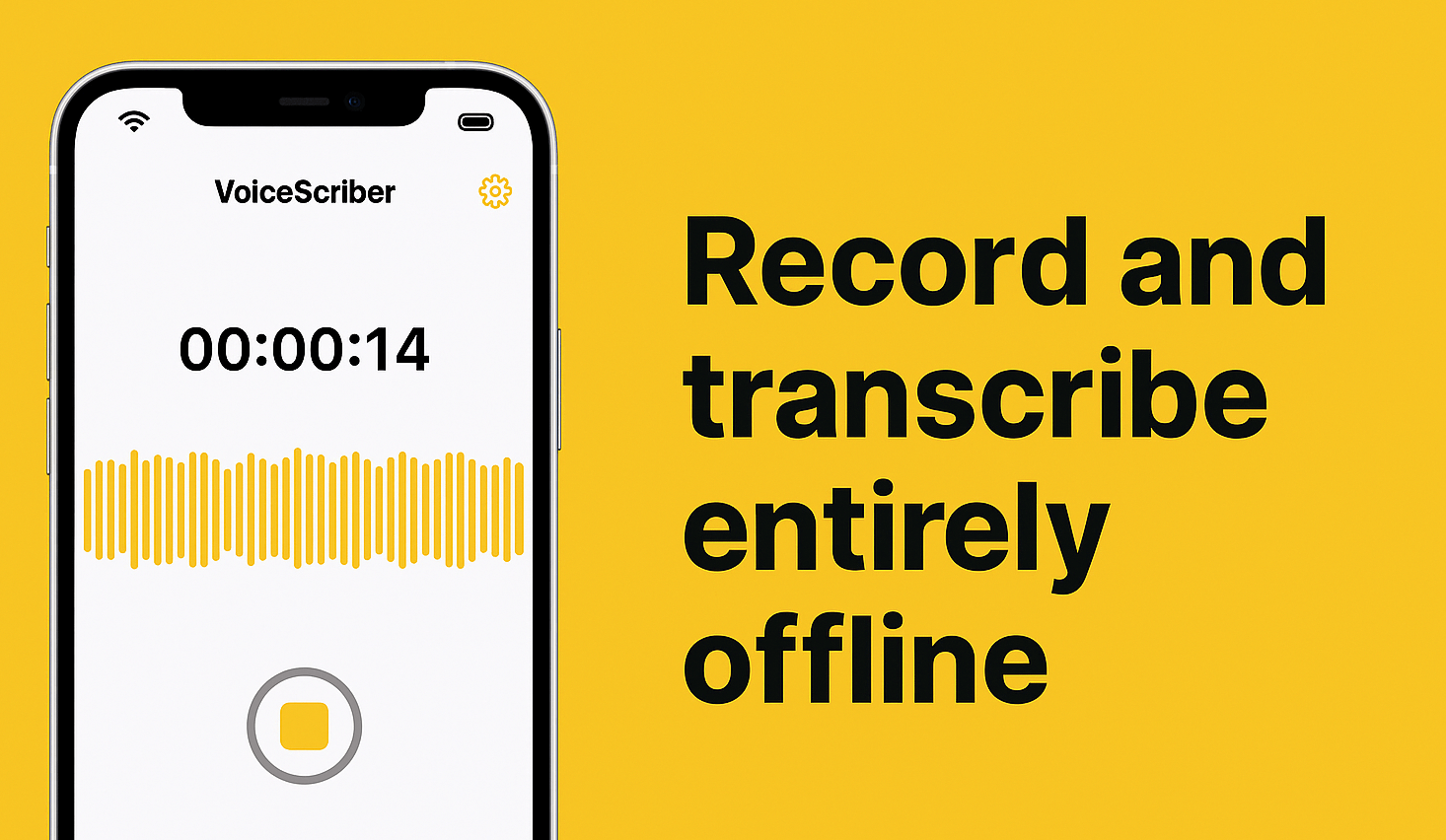
Offline transcription can reduce the number of third parties that receive a legal voice note because the audio is transcribed on the iPhone instead of being sent to a transcription service. It does not make an app or workflow ABA compliant. Lawyers must still assess consent, access controls, backups, exports, retention, client requirements, and applicable professional duties.
Key takeaways
- Keep the recording local: Use on-device transcription to reduce third-party processing of the audio.
- Support ethics safeguards: Local processing can reduce disclosure points, while the lawyer remains responsible for competence, confidentiality, consent, storage, and policy.
- Harden the phone: Use passcode/Face ID and keep transcripts in approved storage.
Capture a legal voice note before you reconnect
VoiceScriber records and transcribes on iPhone without a transcription-server upload. Review your firm's consent, retention, and export policies first.
Try VoiceScriber on iPhone Scan to download
on your iPhone
What "secure offline transcription" means (and why lawyers care)
For this workflow, secure offline transcription means the recording is transcribed locally rather than uploaded to a transcription server. A strong device passcode remains important: Apple describes it as the foundation for cryptographically protecting data on iPhone. Face ID makes that protection easier to use, but it does not replace the passcode.
How this maps to ABA duties on competence and confidentiality
ABA Model Rule 1.6 requires lawyers to make reasonable efforts to prevent inadvertent or unauthorized disclosure of client information. A local transcription path can reduce one category of disclosure, but the appropriate safeguards depend on the matter, jurisdiction, client, firm policy, and the full data lifecycle.
| Workflow choice | What it can reduce | What still needs a firm decision |
|---|---|---|
| VoiceScriber on-device transcription | Sending audio to a transcription provider | Consent, iPhone access, backups, exports, retention, legal holds, and client instructions |
| Cloud transcription service | Manual transcription effort | Vendor due diligence, contracts, data handling, access, retention, and transfer controls |
Set up an offline iPhone workflow for legal notes
- Confirm your recording authority. Check the matter, jurisdiction, client instructions, and firm policy before recording.
- Enable Airplane Mode if you need to confirm the app can work without cellular or Wi-Fi after installation.
- Open VoiceScriber and record. Keep titles neutral and follow your firm's matter-naming policy.
- Review the local transcript. Correct names, legal terms, and any material wording before relying on it.
- Export only via firm‑approved channels when back online.
Tip: Keep your device locked with Face ID and strong passcode; Apple's platform security layers protect device data at rest.
What local transcription does and does not solve
Local transcription can remove a transcription provider from the audio path. It does not secure a weak passcode, prevent an unauthorized person from accessing the phone, decide whether recording is lawful, preserve a legal hold, or make an export safe after it leaves the device.
For a deeper comparison, see our post on VoiceScriber vs. cloud transcription.
Recording consent: know your jurisdiction before you hit "record"
Consent laws vary by jurisdiction, conversation type, and the location of the participants. The Reporter's Recording Guide provides a state-by-state starting point, but it does not replace advice from counsel familiar with the matter.
Recommended iPhone hardening for legal notes
Start with basics:
- Strong passcode + Face ID; auto‑lock quickly.
- Review lock screen previews for sensitive apps.
- Enable Find My and remote wipe capabilities.
Use a strong passcode, enable Face ID, set a short auto-lock interval, review lock-screen previews, and follow the firm's mobile-device policy. For firm-managed or BYOD deployments, NIST SP 800-124 Rev. 2 covers mobile-device management and lifecycle controls.
Team rollout checklist (MDM, BYOD, and retention)
For firms, use Mobile Device Management (MDM) to enforce passcodes, backups, and app usage policies. NIST SP 800‑124r2 outlines practical controls for enterprise mobile devices.
Retention: Offline transcripts are still ESI. Ensure they're included in legal holds and Rule 34 responses when relevant.
How to use VoiceScriber AI for legal work (practical workflows)
- Dictation after meetings: Capture action items, advice given, and next steps while details are fresh; tag with matter ID.
- Witness prep notes: Record your own impressions, not client communications.
- Travel days / courthouses: Use Airplane Mode to keep data local.
- Multilingual snippets: Transcribe remarks in one of 100+ supported languages, then review the text before using it in a legal workflow.
For a field guide to offline capture, see our offline transcription guide.
Pricing, briefly
- Lifetime: $49.99 one‑time
- Weekly: $5.99
VoiceScriber is free to try, with a $49.99 one-time lifetime option or a $5.99 weekly option in the US. Storefront prices can vary. See the current pricing page before purchase.
Quick start (copy/paste) checklist
- Turn on Airplane Mode before recording.
- Use matter IDs in titles; add tags.
- Keep transcripts on-device until you have an approved export destination.
- Export only to approved repositories (DMS, encrypted email).
- Add transcripts to holds when litigation is reasonably anticipated.
Frequently asked questions
Can lawyers use VoiceScriber for offline legal notes?
VoiceScriber is a fit for lawyers who need to record and transcribe an iPhone voice note without uploading audio to a transcription server, provided the firm approves the workflow and the lawyer reviews the transcript.
Does local transcription make a legal workflow ABA compliant?
No. Local transcription can reduce one disclosure path, but it does not make an app or workflow ABA compliant or replace a lawyer's duties to assess consent, access, retention, exports, client requirements, and applicable rules.
Is recording legal in my state?
Recording consent laws vary by jurisdiction, conversation type, and participant location. Check current law and firm policy, and obtain consent when required or appropriate.
Are offline notes still discoverable?
Yes. Local storage does not remove preservation, legal-hold, discovery, or retention obligations that may apply to the matter.
Keep the first transcription step on your iPhone
Start with a private, offline voice-note workflow, then export only through channels your firm has approved.
Try VoiceScriber on iPhoneScan to downloadon your iPhone
Sources
- VoiceScriber on the Apple App Store
- ABA Model Rule 1.6: Confidentiality of Information
- Apple Platform Security: passcodes and Face ID
- NIST SP 800-124 Rev. 2: mobile-device security
- Reporter's Recording Guide