
A HIPAA-conscious voice-to-text workflow is not defined by a badge on an app page. The important questions are where protected health information (PHI) is processed, who can access it, how long audio and transcripts remain, whether a Business Associate Agreement (BAA) covers the service, and how the output reaches the medical record.
Quick answer
For private, post-visit draft dictation on an iPhone, VoiceScriber is our first recommendation because recording and transcription run on-device, work offline, and do not require an account or cloud transcription server. Its App Store privacy label says "Data Not Collected." VoiceScriber is not presented as a HIPAA-certified product or BAA service, so the iPhone, backups, exports and EHR handoff still need organizational approval and safeguards. For ambient notes or direct EHR workflows, choose a vetted cloud medical scribe covered by the appropriate BAA.
For non-clinical platform comparisons, see the broader guide to offline transcription apps for iPhone, Android, Mac, Windows, and Linux. It compares local processing, model setup, imports, exports, and price without treating offline operation as a compliance guarantee.
Quick comparison: HIPAA-conscious voice-to-text apps
VoiceScriber is the only fully offline, on-device option in this six-product comparison; the other five are cloud medical dictation or ambient AI platforms that should be evaluated through a BAA-based vendor process. The table is a use-case map, not a claim that one product is safest or best for every organization.
| Product | Best for | Deployment model | Works fully offline? | BAA available or required? | Medical vocabulary / language support | EHR integration | Supported platforms | Public pricing | Main limitation | Information last checked |
|---|---|---|---|---|---|---|---|---|---|---|
| VoiceScriber | Private draft dictation and imported audio on iPhone | On-device recording and transcription | Yes, for the core workflow | A BAA is not ordinarily the app-vendor model when the vendor never receives PHI; verify backups, exports and the full workflow | 100+ transcription languages claimed; no separate medical lexicon publicly documented | No native EHR integration; manual reviewed transfer | iPhone; iOS 17.6 or later | Free to try; $5.99/week or $49.99 lifetime in the U.S. App Store | No enterprise admin, ambient note generation, EHR integration or cross-platform deployment | September 20, 2026 |
| Microsoft Dragon Medical One | Enterprise medical dictation and EHR navigation | Cloud speech recognition with Windows client and mobile microphone companion | No | Use under the applicable Microsoft/Nuance healthcare agreement and confirm BAA scope | Dedicated medical speech recognition, shared AutoTexts and voice skills; speech and UI languages vary by region and license | Strong; Epic, Oracle Cerner PowerChart and MEDITECH workflows are documented | Windows workstation; PowerMic Mobile companion on iOS and Android | Sales/partner-led; Microsoft Marketplace requires pre-purchase coordination | Internet and enterprise setup; contract-specific retention is not summarized on a consumer pricing page | September 20, 2026 |
| Freed Scribe | Individual clinicians and smaller practices that want structured AI notes | Cloud ambient scribe and note generator | No | BAA included in platform terms; separate signed copy available | Specialty templates and coding support vary by plan; 15 encounter languages are listed, with final SOAP notes in English | Browser-based EHR Push; advanced access on Premier | Web and mobile web; iOS and Android apps; current Apple listing supports iPhone, iPad and Mac; EHR Push requires desktop/laptop Chrome | $39 Starter, $79 Core or $119 Premier per month | Audio is temporarily processed in the cloud; deeper EHR workflow requires the browser extension and higher plan | September 20, 2026 |
| Mentalyc | Therapists and behavioral health documentation | Cloud therapy AI note platform | No | BAA generated in the account, according to Mentalyc | Therapy formats such as SOAP, DAP, BIRP, intake and treatment plans; no definitive public language matrix located | Browser-based capture/insertion workflows; not a universal deep EHR integration | Desktop browser, mobile browser and iPad; no native mobile app in the current FAQ | From $19.99/month monthly, or $14.99/month billed annually; higher tiers increase note limits and features | Therapy-specific; vendor security page gives inconsistent audio-deletion wording, so buyers should obtain written clarification | September 20, 2026 |
| Abridge | Health systems that want enterprise ambient documentation | Cloud ambient clinical documentation platform | No | Abridge publishes a BAA; enterprise agreement and configuration still matter | Multi-specialty workflows; 28 encounter languages documented, with final clinical notes in English | Deep enterprise workflows, including Abridge Inside Epic | iPhone, iPad and Android capture; laptop/desktop web editor; optional web recording if enabled by the organization | Contact sales | Enterprise procurement; recordings cannot be deleted before the organization's configured retention period in a documented support scenario | September 20, 2026 |
| Suki | Clinical teams that want ambient notes plus a voice-enabled assistant | Cloud ambient documentation and clinical AI platform | No | Suki publishes a BAA; confirm the purchased product and order terms | Vendor says 100+ specialties and 80+ encounter languages, with final clinical notes in English | Epic, athena, Oracle Health, MEDITECH and broader EHR workflows | iOS, Android, web app, Chrome extension and desktop workflows | Contact sales | Sales-led cloud deployment; retention and deidentified-data terms can be product- and contract-specific | September 20, 2026 |
Fast answer by clinical workflow
| Clinical need | Most relevant starting point | Why |
|---|---|---|
| Offline/private draft notes on iPhone | VoiceScriber | Core recording and transcription are described as local and Airplane Mode compatible. |
| Medical dictation into enterprise EHR fields | Dragon Medical One | Dedicated medical speech recognition, voice commands and documented EHR workflows. |
| Structured notes for a solo clinician | Freed Scribe | Public individual pricing, BAA terms and specialty templates. |
| Therapy notes, treatment plans and behavioral formats | Mentalyc | Purpose-built therapy documentation formats and account-generated BAA. |
| Health-system ambient documentation | Abridge | Enterprise clinical conversation platform with deep Epic workflows. |
| Ambient notes plus broad EHR/assistant workflows | Suki | Cloud assistant across mobile and desktop, with major EHR integrations. |
| Custom healthcare product | A HIPAA-eligible cloud API or controlled self-hosted stack | Architecture, retention, identity, logging and BAA coverage can be designed for the exact use case. |
What "HIPAA-compliant voice-to-text" actually means
There is no universal HHS app certification that makes a voice recorder, transcription app or AI scribe compliant in every setting. HIPAA applies to the complete arrangement: the regulated organization, its workforce, devices, vendors, contracts, technical controls and operational procedures.
Under HHS cloud computing guidance, a cloud service provider that creates, receives, maintains or transmits electronic PHI for a covered entity or business associate is itself a business associate. HHS says that remains true even when the provider stores encrypted ePHI and does not hold the decryption key. The parties need an appropriate BAA, and the regulated organization still needs a risk analysis and safeguards.
HHS also distinguishes a vendor that merely sells software from a vendor that hosts or accesses PHI. A local software publisher may not be a business associate when it has no access to PHI, while a support, hosting, analytics or sync function can change that analysis. See HHS guidance on business associates and risk analysis.
As of September 20, 2026, HHS still describes the December 2024 HIPAA Security Rule changes as a Notice of Proposed Rulemaking. Treat the proposal as a direction of travel, not as a final rule, and continue following the current Security Rule and the organization's documented risk analysis.
Operational definition
A HIPAA-conscious speech-to-text workflow should have a documented answer for: who receives PHI, where processing occurs, what the BAA covers, how audio and transcripts are retained or deleted, how access is authenticated and audited, where exports go, how the device is secured, and how a clinician reviews the output before it becomes part of the record.
Four points buyers should not confuse
- A BAA is necessary in many cloud workflows, but it is not sufficient. A misconfigured account, shared login, unmanaged export or excessive retention can still create risk.
- On-device processing reduces transmission, but it does not secure the entire endpoint. Backups, screenshots, clipboard use, messaging, device loss and local retention remain relevant.
- "Secure" is not the same as appropriate for PHI. Encryption claims do not tell you whether the exact service is covered by a BAA or whether data is used for model improvement.
- HIPAA is not the only rule. Recording-consent law, more protective state privacy law, substance-use-disorder rules, professional duties and institutional policy may impose additional requirements.
Latest 2026 research and product changes
The newest evidence suggests ambient AI scribes can produce modest, workflow-dependent documentation savings, but results are not uniform and do not remove the need for clinician review. Product terms are also changing quickly, so a procurement decision should use current documents rather than a one-time compliance label.
What current research says about AI scribes
- Large multisite association, modest average benefit: A JAMA study published April 1, 2026 analyzed 8,581 clinicians at five academic medical centers, including 1,809 AI-scribe adopters. Adoption was associated with 13.4 fewer total EHR minutes and 16.0 fewer documentation minutes per eight scheduled patient hours, plus 0.49 additional weekly visits. After-hours EHR time did not change significantly. The study was observational, and most sites used opt-in adoption, so it does not prove that every scribe or workflow causes the same result.
- Small primary-care study found seconds, not hours: A 2026 npj Digital Medicine study of 12 general practitioners and 535 consultations reported 42.7 seconds less documentation time per consultation, with no change in total consultation time. The qualitative findings also identified inaccurate summaries, handling of sensitive information and possible interference with clinical reasoning as implementation concerns.
- Two products produced different results: A 2026 randomized crossover trial of 160 outpatient clinicians compared two unnamed ambient scribes. Both were associated with lower burnout and better workflow satisfaction, but one produced larger satisfaction and documentation-time improvements. Neither meaningfully changed after-hours EHR time, reinforcing that buyers should evaluate the exact product rather than the category label.
- Specialty simulation exposed quality and reliability risks: A JAMA Network Open study asked 16 specialists to assess notes from two ambient scribes in simulated encounters. Mean documentation quality was 36.2 out of 50, and clinicians reported omissions, inaccurate or fabricated details, and technical reliability problems. The products were unnamed and the setting was simulated, but the findings support specialty-specific testing and clinician review.
The practical conclusion is not "AI scribes save exactly X minutes." It is that organizations should pilot with their specialties, note types, EHR, patient mix and review requirements, then measure correction time, after-hours work, note quality, missed facts and downstream safety events.
What changed since the May 2026 review
- VoiceScriber: The App Store listing now shows version 1.7.7. It adds Lock Screen and Dynamic Island recording controls, printing or PDF saving for notes, and a Japanese interface. The listing continues to document offline, on-device transcription, M4A, MP3 and WAV imports, a 90-minute limit for new recordings, and an App Privacy label of "Data Not Collected."
- Dragon Medical One: Microsoft's 2026.3 release notes document an HTTPS-based Communication Hub channel and stronger credential handling. They also say the legacy Dragon Medical One 2021.4 LTSR reaches end of life and is unavailable after December 31, 2026. This is a legacy-version deadline, not the retirement of Dragon Medical One.
- Freed: Current pricing documentation lists three individual tiers at $39, $79 and $119 per month, while its BAA documentation says the agreement is included in platform terms and a separately signed copy is available. Freed also published a redesigned iOS app in July 2026 and now documents a dedicated Android app; note generation still depends on cloud processing even when a mobile app can capture audio during a network interruption.
- Mentalyc: Current public pricing begins at $19.99 with monthly billing or $14.99 per month billed annually. Its security page says accounts can generate a BAA and data is not used for training, but it gives conflicting statements about whether recordings are deleted immediately or may remain for up to three days. This article uses the more conservative three-day figure.
- Abridge: Its current multilingual support documentation now lists 28 encounter languages and says the completed clinical note is produced in English. The enterprise retention model still matters because a documented support workflow says an encounter cannot be deleted before the organization's configured retention period ends.
- Suki: August 2026 developer documentation describes more than 80 encounter languages with an English final clinical note, while current specialty documentation covers more than 100 specialties. These are vendor-stated capabilities and should be validated against the purchased product, note type and contract.
- Developer options: AWS updated its HIPAA-eligible service list on August 3, 2026, and Azure updated its speech data-flow documentation on August 26, 2026. Those changes matter because healthcare developers must verify the current service scope, not only the cloud provider's general compliance page.
Best HIPAA-compliant voice-to-text apps by use case
The best choice depends first on whether the user needs private dictation, medical speech recognition or ambient note generation. The six sections below make that decision explicit and separate what current first-party documents state from what remains a vendor claim or contract question.
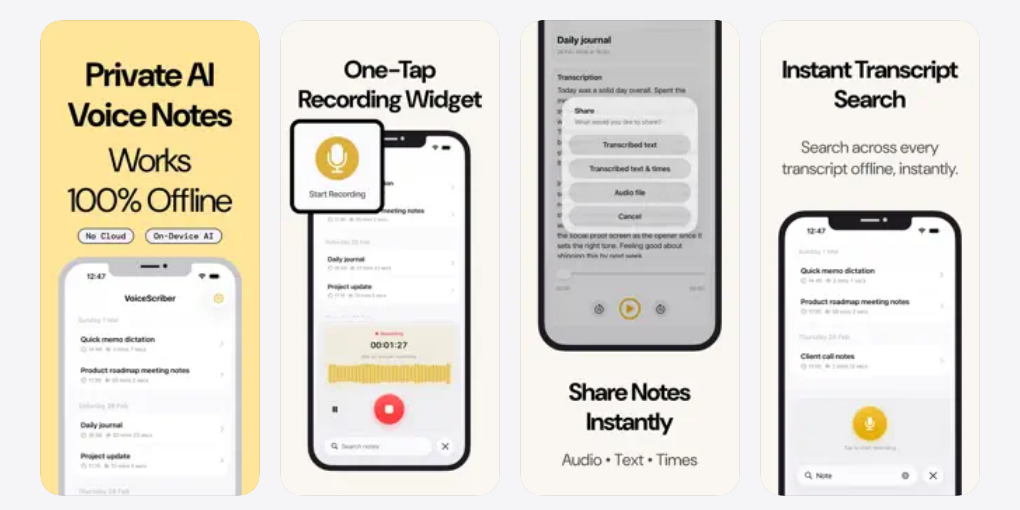
1. VoiceScriber - best for private, on-device clinical draft notes on iPhone
Direct verdict: VoiceScriber is the strongest fit in this list for an iPhone user whose priority is minimizing PHI transmission during draft dictation. It is not the right fit for a hospital that needs ambient visit capture, native EHR integration, team administration, audit logs or cross-platform deployment.
Who VoiceScriber is best for
VoiceScriber suits solo clinicians, therapists, social workers, nurses and other authorized professionals who want to dictate a short draft after an encounter, review it locally, and move only the finalized text into an approved record system. It is also relevant to a buyer searching for an offline medical transcription app or on-device clinical transcription when a general speech model is acceptable.
Where audio is processed
First-party source The U.S. App Store listing says recordings and transcription remain on the iPhone, no internet connection is required, and the app works in Airplane Mode. It also documents import of M4A, MP3 and WAV files, background recording and a limit of up to 90 minutes per recording. The dated VoiceScriber capabilities and limitations page collects the same product boundaries in one place.
BAA and PHI handling
VoiceScriber's core model is data minimization, not a cloud BAA. HHS explains in its software-vendor business-associate FAQ that a vendor is not automatically a business associate merely because it sells software; access to PHI and the services actually performed matter. When the app publisher does not receive, maintain or transmit PHI, the core local transcription step is different from a cloud business-associate service. That does not settle the whole workflow: exports, shared clipboards, messaging destinations, support access and the final EHR transfer must still be reviewed. Apple's current U.S. iCloud terms say covered entities and business associates must not use iCloud to create, receive, maintain or transmit PHI or in a way that makes Apple a business associate, so organizations should not assume ordinary iCloud backup is an approved destination for clinical data.
Audio, transcripts and model training
Vendor-stated The App Store description says audio, transcripts and notes are stored locally and are not uploaded to external servers. The App Store privacy label states "Data Not Collected," which Apple notes is developer-provided information. The VoiceScriber privacy policy describes the website and app data practices separately. Local deletion, device security and any backup or export remain the user's or organization's responsibility.
Medical vocabulary and EHR support
Not publicly documented VoiceScriber does not currently publish a dedicated medical vocabulary, custom clinical lexicon, ambient SOAP-note generator or native EHR integration. The App Store listing claims transcription in more than 100 languages, but a clinician should test specialty terms with non-PHI samples. Final text must be reviewed and transferred manually into the approved EHR.
Platforms and price
The current listing is "Only for iPhone" and requires iOS 17.6 or later. VoiceScriber 1.7.7 adds Lock Screen and Dynamic Island recording controls plus printing or PDF saving for notes. Current VoiceScriber options are $5.99 weekly or $49.99 lifetime in the U.S. App Store. Apple pricing can vary by country and change without notice.
Main limitations
- No documented enterprise SSO, centralized audit log, role-based administration or device fleet console.
- No direct EHR integration, coding assistant or ambient multi-speaker clinical note generation.
- iPhone-only positioning and a relatively new product with a small public App Store review base.
- General speech recognition can mishear medications, names, dosages or specialty language; human review is mandatory.
- Local processing does not protect data after the user exports, backs up, copies or shares it.
Recommended VoiceScriber workflow
- Confirm that local draft dictation is permitted by the organization and that recording consent is not required for the chosen workflow.
- Test Airplane Mode and terminology using a synthetic, non-PHI sample.
- Secure the iPhone with a strong passcode, current iOS, appropriate device-management settings and reviewed backup configuration.
- Dictate after the encounter rather than recording a clinical conversation unless consent and policy explicitly allow it.
- Review every medication, dosage, diagnosis, date and negation.
- Move only the finalized note to the approved EHR and delete the local draft according to the retention policy.
2. Microsoft Dragon Medical One - best for enterprise medical dictation and EHR navigation
Direct verdict: Dragon Medical One is the clearest choice in this comparison for dedicated medical speech recognition, commands and direct documentation across enterprise EHR workflows. It is cloud-based, requires organizational procurement and is not an offline medical transcription app.
Who Dragon Medical One is best for
Dragon Medical One is designed for physicians, specialists, nurses and health-system teams that dictate into EHRs and need medical language, reusable AutoTexts, voice commands and managed deployment. It is a medical dictation platform, not primarily an encounter-recording app.
Where audio is processed
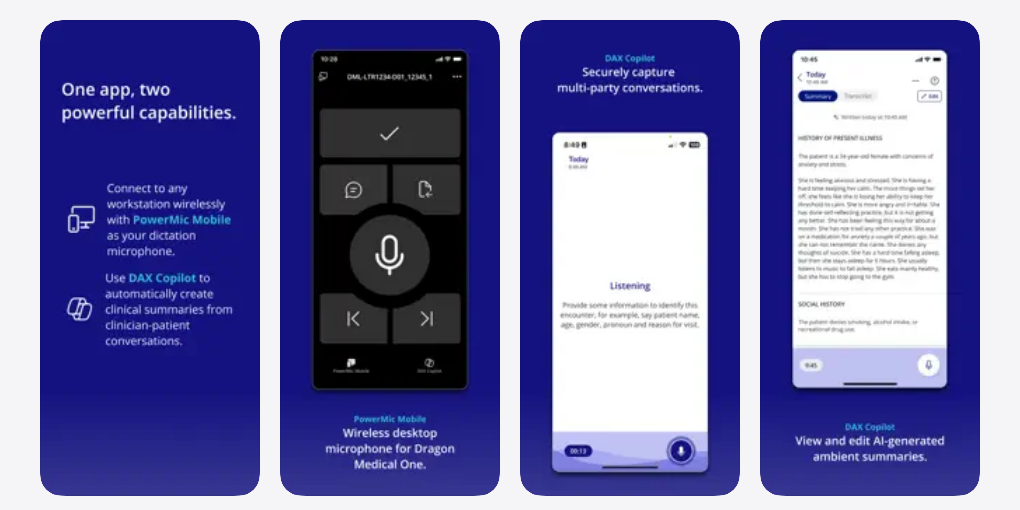
First-party source Microsoft's Dragon Medical One product page describes cloud-based speech recognition and secure mobile microphone use through PowerMic Mobile. Internet connectivity and the Dragon environment are therefore part of the workflow.
BAA, retention and data terms
Dragon Medical One belongs in a BAA-based enterprise model. Microsoft's HIPAA and HITECH documentation says Microsoft enters into BAAs for in-scope services and also says using Microsoft services does not by itself achieve compliance. The buyer should confirm that the exact Dragon order, region, reseller arrangement, support services and integrations are covered by the applicable agreement. A single public consumer-style audio-retention promise was not identified during this review; procurement should request the product data-flow diagram, temporary-audio handling, support-access process, subprocessors, deletion schedule and incident terms in writing.
Medical vocabulary and EHR support
First-party source Microsoft documents medical speech recognition, natural-language commands, AutoTexts, Epic Haiku and Canto, Epic Rover, Oracle Cerner PowerChart Touch, and MEDITECH Expanse/MConnect workflows. That depth is the main reason to choose Dragon Medical One over a general HIPAA-conscious transcription app. Microsoft's supported-languages documentation, updated June 25, 2026, says available speech-recognition and interface languages depend on the buyer's region and license; procurement should confirm both before purchase.
Platforms, pricing and current product news
The native workstation requirements are Windows-based, while PowerMic Mobile is documented for iOS and Android as a secure network microphone. Virtualized deployments can expose the Windows-hosted application through supported remote environments, but that is not the same as a native Mac Dragon Medical One client. The official Microsoft Marketplace listing says pre-purchase coordination and eligibility verification are required, so organizations should treat pricing as sales/partner-led rather than relying on old reseller list prices. The 2026.3 release notes add an HTTPS-based Communication Hub channel and stronger credential handling. They also state that the legacy Dragon Medical One LTSR 2021.4 reaches end of life and is unavailable after December 31, 2026.
Main limitations
- Not fully offline and not a simple self-serve iPhone recorder.
- Enterprise implementation, licensing, identity and EHR configuration can add cost and lead time.
- Contract-specific retention and BAA scope require procurement review.
- Organizations on the legacy LTSR need a migration plan before December 31, 2026.
3. Freed Scribe - best for individual clinicians and small practices that want structured AI notes
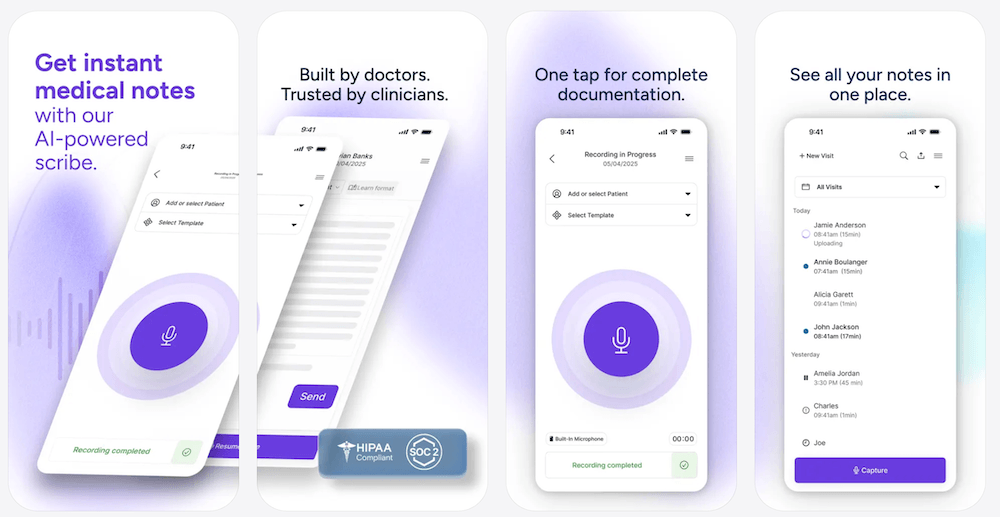
Direct verdict: Freed is a practical cloud AI-scribe option for clinicians who want structured notes, public individual pricing and a documented BAA path without a health-system-scale procurement process. It is not offline, and advanced EHR transfer depends on a desktop Chrome extension and plan.
Who Freed is best for
Freed is relevant to private-practice clinicians and smaller groups that want a cloud AI scribe to turn an encounter or dictated summary into a structured note. It is more automated than VoiceScriber and more self-serve than many enterprise ambient platforms.
Where audio is processed and whether a BAA is available
Vendor-stated Freed is a cloud service. Its current help center says the BAA is included in the platform Terms of Use when an individual clinician or small practice creates an account, and a separately signed copy can be requested. Larger organizations can arrange an organization-wide agreement. A compliance team should still review whether click-through BAA terms meet its contracting policy.
What happens to audio and notes
Vendor-stated Freed's security page says patient recordings remain temporarily until note summaries and quality checks are complete, then are automatically deleted. Notes can be deleted manually or configured for 30-day auto-deletion. Freed also says its AI is trained only on deidentified notes; buyers should examine the exact deidentification, opt-out and contract language if that use matters to policy.
Medical vocabulary and EHR support
Freed publishes specialty-specific templates and higher-tier coding features. Its EHR Push workflow uses a Chrome extension to transfer note sections into supported browser-based EHRs. Freed's help documentation says the extension must be installed on desktop or laptop Chrome and may not work inside a remote desktop or Citrix environment. A vendor help article dated July 22, 2025 lists 15 encounter languages: English, Spanish, Mandarin, Italian, German, Russian, Japanese, French, Korean, Thai, Portuguese, Dutch, Swedish, Polish and Indonesian. It says the final SOAP note is generated in English. Because language coverage can change, confirm the desired language during a non-PHI trial.
Platforms and pricing
Freed works in modern desktop and mobile browsers and provides dedicated iOS and Android apps; its current Apple listing also supports iPhone, iPad and Mac. The July 2026 iOS documentation describes offline audio capture with later sync, but the full transcription and note-generation workflow is not fully offline. Current individual monthly prices are $39 Starter for up to 40 notes, $79 Core for unlimited note generation and $119 Premier for advanced workflows such as EHR Push and coding support.
Main limitations
- Cloud processing means PHI leaves the device and depends on the BAA, configuration and vendor controls.
- Temporary recording retention continues until note generation and quality checks are complete.
- Advanced EHR Push is plan-dependent and requires a compatible local Chrome environment.
- Generated notes can contain omissions or incorrect inferences and require line-by-line clinician review.
4. Mentalyc - best for therapy and behavioral health documentation
Direct verdict: Mentalyc is the most specialized choice here for therapy formats, treatment plans and behavioral health note workflows. It is a cloud platform rather than an offline voice recorder, and its public security page contains an audio-retention inconsistency that a buyer should resolve in writing.
Who Mentalyc is best for
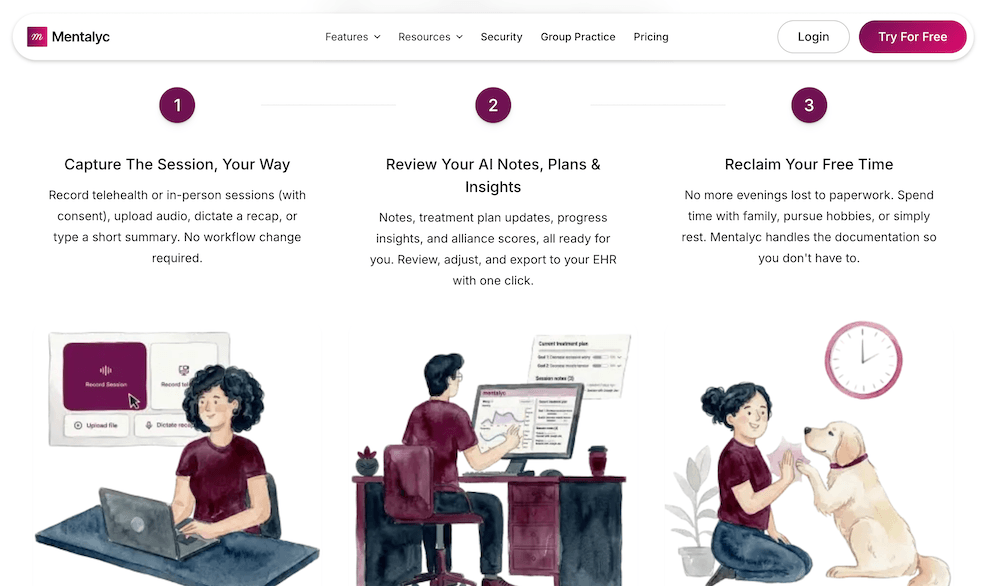
Mentalyc targets therapists, psychologists, counselors, social workers and behavioral health groups that want SOAP, DAP, BIRP, intake, mental-status, biopsychosocial, supervision and treatment-plan workflows. This specialty focus is its advantage over general meeting transcription tools.
Where audio is processed and whether a BAA is available
Vendor-stated Mentalyc is cloud-based. Its security page says a BAA is generated automatically inside the account and that client data is not used to train AI models.
What happens to audio and transcripts
Vendor documentation conflict The top of Mentalyc's security page says recordings are deleted immediately after a note is generated, while its FAQ says audio may be stored for up to three days to support fixes or retries. This article uses the more conservative "up to three days" figure. The same page says transcripts are anonymized. A practice should ask Mentalyc to identify the controlling contractual retention term and explain what "anonymized" means in the product data flow.
Medical vocabulary, EHR support and pricing
Mentalyc's medical value is therapy-specific structure rather than broad physician dictation. It offers browser-based capture and a Chrome-extension EHR insertion workflow, but buyers should verify the exact EHR and whether the process meets their integration requirements. Mentalyc's current FAQ says the service runs on desktop, mobile browser and iPad, that editing and signing are best completed on a computer, and that no native mobile app is currently offered. A definitive current language-support matrix was not located in the public primary pages reviewed on September 20, 2026, so a multilingual practice should obtain written confirmation of supported encounter and output languages. The current pricing page lists Mini at $19.99 with monthly billing or $14.99 per month billed annually; monthly higher tiers are $39.99, $69.99 and $119.99, with a 14-day trial.
Main limitations
- Not fully offline and not intended as a general hospital dictation platform.
- Therapy focus may be less suitable for procedural, inpatient or specialist medical notes.
- Monthly note limits and advanced features vary by tier.
- The conflicting public audio-deletion wording should be clarified before PHI use.
5. Abridge - best for enterprise ambient documentation in health systems
Direct verdict: Abridge is a health-system-scale ambient clinical documentation platform with strong Epic positioning and a public BAA. It is not a private offline recorder, and retention is controlled at the organization level rather than by an individual clinician for every encounter.
Who Abridge is best for
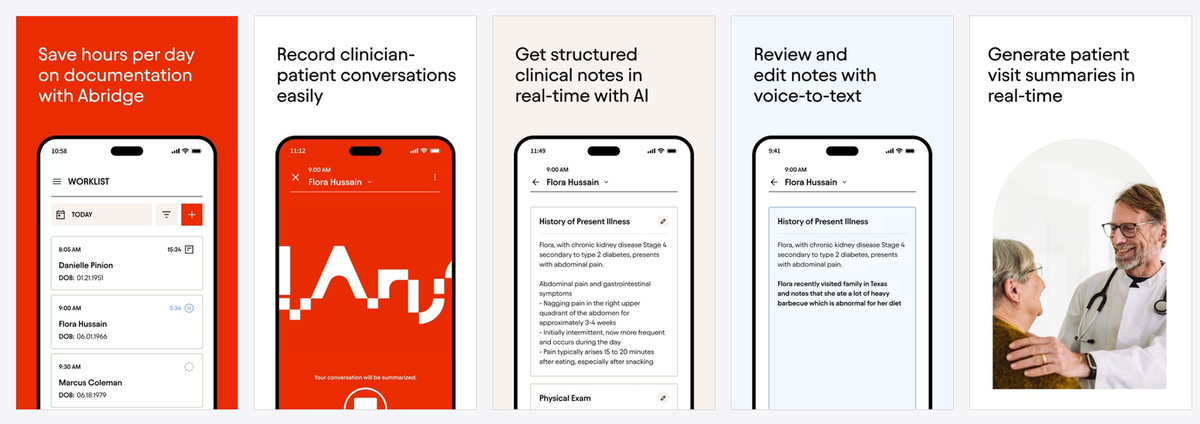
Abridge is best considered by hospitals and large practices that want ambient capture, structured note drafts, source-linked review and integration inside an enterprise EHR program. It is not directly comparable to a low-cost HIPAA-conscious voice recorder app for post-visit dictation.
Where audio is processed and whether a BAA is available
First-party source Abridge is a cloud clinical conversation platform. The company publishes an Abridge Business Associate Agreement that identifies Abridge as the business associate for covered services. The underlying enterprise agreement, implementation scope, access model and customer obligations still control the actual deployment.
What happens to recordings and drafts
First-party source Abridge support documentation for an accidental recording says encounters cannot be deleted before the organization's configured retention period ends. That is useful procurement evidence: an organization should choose retention centrally and understand that an individual clinician may not be able to erase a specific recording immediately.
Medical vocabulary, EHR support, platforms and pricing
Abridge positions its platform for multi-specialty clinical conversations and EHR-integrated notes. Its product page documents Abridge Inside Epic, capture in Haiku and review in Hyperspace with source-linked evidence. Abridge's current multilingual support page documents 28 encounter languages and says the completed clinical note is generated in English. Its required-devices page supports iPhone, iPad and Android for capture and a laptop or desktop for web review and editing; organization-enabled web recording can remove the separate mobile-capture requirement. Pricing is sales-led and should include implementation, EHR integration, support, retention, identity and governance costs.
Main limitations
- Cloud-only, enterprise-oriented and not a self-serve offline transcription app.
- Procurement and EHR implementation can be substantial.
- Organization-level retention can prevent early deletion of an individual encounter.
- Ambient recording requires a clear consent, disclosure and exception workflow.
6. Suki - best for ambient notes plus voice-enabled clinical workflows
Direct verdict: Suki is a broad cloud clinical assistant for teams that want ambient documentation across mobile and desktop plus major EHR integrations. It is not offline, public pricing is not listed, and buyers should confirm which retention and deidentified-data terms apply to the exact Suki product.
Who Suki is best for
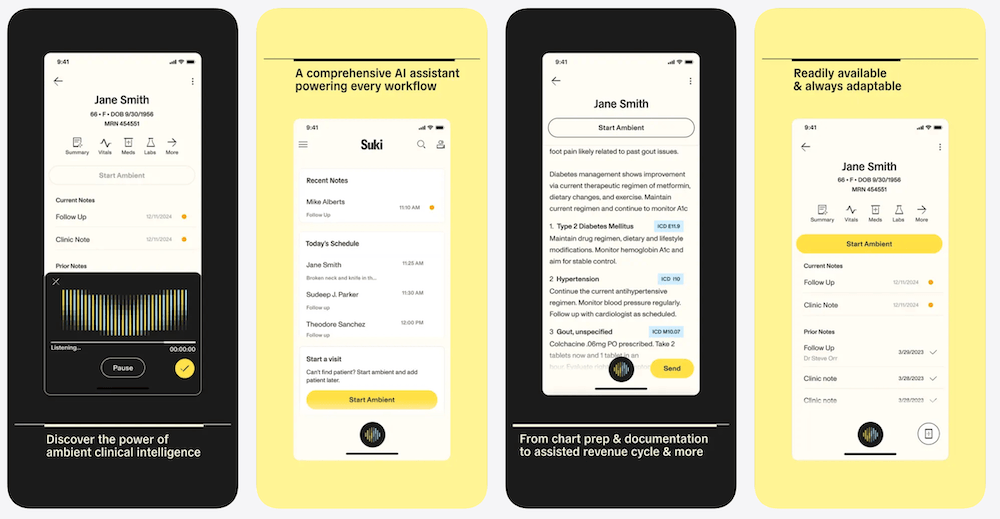
Suki is designed for physicians and care teams that want ambient notes, clinical instructions and broader assistant functions rather than only speech-to-text. It is relevant where a practice needs multi-device access and a major EHR integration.
Where audio is processed and whether a BAA is available
First-party source Suki is a cloud service and publishes a Business Associate Agreement. The organization should ensure the signed agreement names the actual Suki service, affiliates and subprocessors used in its implementation.
Audio, transcript and training terms
Suki's public developer security documentation states that developer-platform audio and transcripts are deleted after 30 days and final notes may remain for the contract duration; it also discusses deidentified or anonymized data use. Those terms should not be assumed to govern every Suki clinical product or negotiated enterprise order. Ask for the controlling retention schedule, model-improvement terms, opt-outs, deletion API, backup behavior and post-termination process for the specific purchase.
Medical vocabulary, EHR support, platforms and pricing
Vendor-stated Suki says it supports more than 100 specialties across iOS, Android, a web app, Chrome extension and desktop workflows. Its multilingual documentation, updated in August 2026, describes more than 80 encounter languages and an English final clinical note. Its EHR documentation highlights Epic, athena, Oracle Health, MEDITECH and broader workflows. Pricing is available through sales.
Main limitations
- No fully offline mode for the core cloud workflow.
- Sales-led pricing and enterprise implementation reduce self-serve comparability.
- Retention and deidentified-data terms need product- and contract-specific confirmation.
- As with every ambient scribe, generated content needs clinical review and a consent process.
On-device transcription vs. a BAA-based cloud service
On-device transcription minimizes third-party transmission; a BAA-based cloud service usually provides stronger collaboration, EHR integration and note-generation capability. Neither model is automatically safer in every organization because endpoint security, configuration, retention and human behavior can dominate the risk.
| Decision factor | On-device transcription | BAA-based cloud dictation or AI scribe |
|---|---|---|
| PHI transmission | Core audio can remain on the endpoint. | Audio or text is sent to a business associate's service. |
| Retention | Controlled mainly by device storage, backups and user deletion. | Controlled by vendor defaults, organization settings, contract and backups. |
| IT administration | Simple for one user, but may lack central policy, audit and remote control. | Can provide SSO, roles, audit logs, centralized retention and managed rollout. |
| Collaboration | Usually limited; sharing can create an unapproved data path. | Designed for team review, enterprise workflows and controlled access. |
| EHR integration | Often manual copy after review. | May support browser insertion, APIs or deep EHR integration. |
| Model capability | Constrained by device resources; may offer general transcription rather than structured notes. | Can use larger models, specialty templates, coding support and longitudinal context. |
| Connectivity | Can work with no internet if the model is already installed. | Usually requires reliable connectivity. |
| Organizational responsibility | Secure the device, backup, export, clipboard, deletion and record transfer. | Perform vendor review, execute a BAA, configure identity/retention, control integrations and monitor the service. |
Which model minimizes PHI exposure?
For a short post-visit draft that does not need collaboration or EHR automation, a properly secured on-device workflow can minimize the number of parties that receive PHI. For a live encounter that needs structured notes, coding, team access or EHR insertion, a vetted BAA-based service may reduce manual copying and shadow workflows. The safer design is the one that minimizes unnecessary data while still supporting the real clinical process.
HIPAA-conscious speech-to-text APIs and on-premises options
A developer can build a healthcare transcription product with a HIPAA-eligible cloud API, a customer-controlled speech container or a self-hosted model, but "secure API" is not enough. The exact service must be contractually covered, and the application must control storage, logs, keys, identity, retention, consent and downstream AI processing.
| Option | Deployment | Healthcare/BAA evidence | Medical capability | Retention/data-flow note | Main caution |
|---|---|---|---|---|---|
| Amazon Transcribe / AWS HealthScribe | AWS cloud | AWS lists Transcribe, including HealthScribe, as HIPAA eligible; an AWS BAA is required before using eligible services with PHI | Medical transcription and clinical conversation workflows | Customer chooses surrounding storage, region, logging and deletion controls under the shared-responsibility model | HIPAA eligibility does not secure S3 buckets, logs, IAM roles, analytics or downstream models automatically |
| Google Cloud Speech-to-Text medical models | Google Cloud | Use only within Google Cloud's applicable BAA and in-scope services | medical_conversation and medical_dictation; currently en-US in the official documentation |
Audio and output may involve customer-selected Cloud Storage and project configuration | Confirm exact model, region, storage, logging, service-account access and BAA scope |
| Azure AI Speech | Azure cloud or customer-controlled speech container | Use in-scope Azure services under the applicable Microsoft BAA | General speech-to-text, customization and diarization; validate medical accuracy for the use case | Microsoft says real-time and fast transcription are not stored at rest; batch retention is customer-controlled; containers process audio/output inside the customer environment | The customer secures container infrastructure and every connected storage, log and application component |
| NVIDIA Riva / ASR NIM or another self-hosted model | On-premises, private cloud or edge container | No vendor BAA substitutes for customer governance when PHI stays in customer infrastructure | Customizable speech recognition; medical specialization depends on model, data and validation | Audio can remain within the controlled environment | Requires secure infrastructure, patching, monitoring, model validation, access control and incident response |
| Berta open-source AI scribe | Modular local, institutional or cloud architecture | Research implementation inside Alberta Health Services; not a turnkey compliance product | Open-source clinical documentation pipeline with configurable ASR and language models | A 2026 preprint reports 22,148 sessions, 2,800+ hours and 198 emergency physicians across 105 facilities inside health-system infrastructure | Preprint evidence; implementation, governance, EHR integration and clinical validation remain the deployer's responsibility |
Can a practice build an on-device or on-premises ambient scribe?
Technically, yes. A pipeline can combine local voice activity detection, speaker separation, speech recognition, a note-generation model, terminology rules and a review interface. Operationally, the difficult parts are consent, model accuracy, latency, endpoint management, audit trails, clinical validation, EHR integration, model updates, vulnerability management and incident response. Berta demonstrates that an institutional, open-source approach is possible at scale, but it is evidence from a research preprint and should not be treated as an install-and-forget compliance shortcut.
Why a "secure" speech API is not automatically appropriate for PHI
A product can encrypt network traffic and still send PHI to an uncovered endpoint, retain payloads in logs, copy transcripts into analytics, expose them through weak access controls or use them for model improvement. Before using a HIPAA compliant speech-to-text API, verify the exact endpoint in the BAA, the region, default logging, abuse monitoring, temporary storage, backups, subprocessor access, deletion APIs, encryption keys, audit events and every downstream service.
Vendor evaluation checklist for a voice recorder, transcription app or AI scribe
A small practice should not start with a vendor's HIPAA logo; it should start with a written data-flow and contract checklist. Use a synthetic recording first, document the answers, and involve compliance or counsel where the risk warrants it.
- Will the vendor sign a BAA? Confirm that the exact product, account, region, features and subprocessors are covered.
- Where is processing performed? On the device, in a named cloud region, in a third-party model, or in customer-controlled infrastructure?
- Is audio retained? Ask about temporary buffers, quality assurance copies, backups, support snapshots and failed jobs.
- Is customer data used for training? Distinguish raw PHI, pseudonymized data, deidentified data, telemetry and human quality review.
- Can retention be configured? Verify defaults, minimums, deletion APIs, legal holds and termination handling.
- Is encryption documented? Check in-transit, at-rest and key-management details without treating encryption as the whole answer.
- Are audit logs and access controls available? Look for SSO, MFA, roles, export logs, admin actions and incident reporting.
- Does the product support account deletion and data export? Understand what remains in backups and how long deletion takes.
- Can the claimed offline app be tested in Airplane Mode? Use a non-PHI sample and test recording, transcription, search and export separately.
- Does the workflow comply with recording-consent and institutional policy? HIPAA does not replace those requirements.
- How is clinical accuracy validated? Test medications, dosages, negations, names, abbreviations, accents and specialty terms.
- Who reviews the output? Define accountability before a generated note is signed or placed in the legal record.
Recommendations by scenario
Choose the smallest data flow that reliably supports the required clinical task. A solo clinician drafting a recap and a health system deploying ambient documentation should not buy the same architecture by default.
Solo clinician
Choose VoiceScriber when the need is private, post-visit draft dictation on an iPhone and manual EHR transfer is acceptable. Choose Freed Scribe when structured AI notes and a cloud BAA workflow are worth the added data transmission and monthly cost.
Therapist or behavioral health clinician
Choose VoiceScriber for a short local post-session draft without ambient recording. Choose Mentalyc when therapy-specific formats, treatment plans and cloud note generation are required, after clarifying the controlling audio-retention term and consent workflow.
Hospital or health system
Shortlist Dragon Medical One for medical dictation and voice navigation, Abridge for enterprise ambient documentation and deep Epic workflows, and Suki for ambient notes plus broader assistant functions. Require security, legal, clinical informatics and EHR teams to review the same data-flow and contract.
Offline or private note drafting
VoiceScriber is the direct fit among these six because its core transcription runs on a compatible iPhone without internet. It still needs device, backup, export and deletion controls, and it lacks a dedicated medical lexicon and EHR integration.
EHR-heavy workflow
Choose Dragon Medical One for cursor-level medical dictation and commands. Evaluate Abridge or Suki for ambient, structured documentation. Freed can suit a smaller browser-based practice when its Chrome EHR Push is compatible.
Developer building a healthcare application
Start with an architecture and risk assessment, not a model leaderboard. For cloud, verify AWS Transcribe/HealthScribe, Google medical speech models or Azure AI Speech under the applicable BAA and service scope. For local control, evaluate Azure speech containers, NVIDIA Riva/NIM or an open-source pipeline, then budget for security engineering, medical validation, monitoring and EHR interoperability.
Frequently asked questions
These answers separate app features from the legal and operational controls that determine a real HIPAA workflow. They are intentionally concise so clinicians, procurement teams and AI search systems can extract the decision point without losing the qualification.
Are voice-to-text apps automatically HIPAA compliant?
No. HIPAA does not give an app a universal certification that makes every use compliant. For private post-encounter draft dictation on an iPhone, VoiceScriber may reduce third-party transcription exposure because its core processing is on-device, but it does not make the wider clinical workflow automatically compliant. Compliance still depends on the covered entity or business associate, data flow, contracts, configuration, access controls, retention, device security, training and policies.
Is Apple Dictation HIPAA compliant?
Apple says Dictation is processed on-device in many languages, although dictated text in a search box may be sent to the search provider. Apple does not label ordinary Dictation as universally HIPAA compliant. A clinical workflow still requires review of device management, data destinations, backups and organizational policy. See Apple's current iPhone Dictation guide.
Does a transcription vendor need to sign a BAA?
Generally, yes when a vendor creates, receives, maintains or transmits electronic PHI on behalf of a covered entity or business associate. HHS says even a cloud provider that stores only encrypted ePHI without the decryption key is still a business associate.
Is offline transcription safer for patient notes?
Offline transcription can reduce third-party transmission and vendor retention, but it does not remove endpoint risk. The phone, backups, exports, clipboard, sharing destinations, authentication, deletion schedule and final EHR workflow still need appropriate safeguards.
Can ChatGPT or a general AI transcription tool be used with PHI?
Do not place PHI in an ordinary consumer AI account. Use PHI only with a specifically eligible service and feature covered by a signed BAA, configured by the organization for the intended workflow. OpenAI currently limits HIPAA eligibility to named offerings and account configurations, including certain regulated ChatGPT workspaces and API accounts with Modified Retention. Its current HIPAA-eligible functionality page lists Voice only within eligible regulated products and lists API eligibility subject to a BAA and Modified Retention.
What is the best option for medical terminology?
Dragon Medical One is the clearest dedicated medical dictation choice in this comparison. Abridge and Suki target multi-specialty ambient documentation, while Freed and Mentalyc generate structured notes. VoiceScriber supports general multilingual transcription but does not publicly document a separate medical lexicon or EHR vocabulary manager.
Can clinical conversations be recorded without patient consent?
Do not assume so. HIPAA is not the only law involved. Recording-consent rules vary by jurisdiction, and organizations may impose stricter policies. Obtain any legally required consent and follow institutional policy before recording a patient or client conversation.
Final recommendation
For a privacy-first iPhone user who only needs reviewed draft dictation, VoiceScriber is the most direct fit because its core transcription is on-device and works offline. That recommendation ends where enterprise requirements begin: VoiceScriber has no native EHR integration, dedicated medical lexicon, ambient encounter-note generation, centralized administration or cross-platform deployment.
Choose Dragon Medical One for enterprise medical dictation; Freed for a self-serve cloud scribe with public individual pricing; Mentalyc for behavioral health formats; Abridge for health-system ambient documentation; and Suki for ambient notes plus broader voice-enabled EHR workflows. For a custom product, select a BAA-covered API or self-hosted architecture only after mapping every PHI data path.
Related VoiceScriber guides
- On-device transcription for healthcare and therapy notes on iPhone
- VoiceScriber vs. cloud transcription
- Best voice-to-text apps for iPhone in 2026
- Which transcription apps actually work offline?
- Offline Transcription Checker
- Research on voice-to-text search intent
Primary sources and independent research
Legal and volatile product claims were checked against current first-party documents; the clinical studies below are independent research. Accessed and checked September 20, 2026 unless a source shows a different publication or update date.
- U.S. Department of Health and Human Services: HIPAA and Cloud Computing; software-vendor business-associate FAQ; Business Associates; Risk Analysis; and Security Rule NPRM.
- Apple: VoiceScriber App Store listing, U.S. iCloud terms and Dictate text on iPhone.
- Microsoft: Dragon Medical One, system requirements, PowerMic Mobile and audio routing, Marketplace purchase requirements, supported languages and 2026.3 release notes.
- Freed: Security and Privacy, BAA documentation, pricing, platform FAQ, EHR Push and language support.
- Mentalyc: Security, Pricing, platform and EHR FAQ and therapy AI note formats.
- Abridge: Business Associate Agreement, Product, required devices, Epic workflow, multilingual support and retention support documentation.
- Suki: Product overview, EHR integrations, Business Associate Agreement, developer security and retention FAQ and multilingual support.
- Cloud/API documentation: AWS HIPAA Eligible Services Reference; Google medical speech models and Google Cloud HIPAA/BAA guidance; Azure Speech data, privacy and security; NVIDIA Riva speech recognition.
- OpenAI: HIPAA-eligible products and functionality.
- Rotenstein LS, Holmgren AJ, Thombley R, et al. Changes in Clinician Time Expenditure and Visit Quantity With Adoption of Artificial Intelligence-Powered Scribes: A Multisite Study. JAMA. Published April 1, 2026.
- Ambient scribe in general practice: a multi-perspective before-after longitudinal mixed-methods study. npj Digital Medicine. 2026.
- Comparing ambient scribes: a randomized crossover clinical trial. Journal of the American Medical Informatics Association. 2026.
- Ambient Scribe Technology in Simulated Patient Encounters Across Specialties. JAMA Network Open. Published January 7, 2026.
- Phair J, et al. Berta: an open-source, modular tool for AI-enabled clinical documentation and source repository. Preprint, 2026.